Sunday, October 25, 2009

Wetland Plant of the Week #30

Osmunda cinnamomea

“Cinnamon Fern”

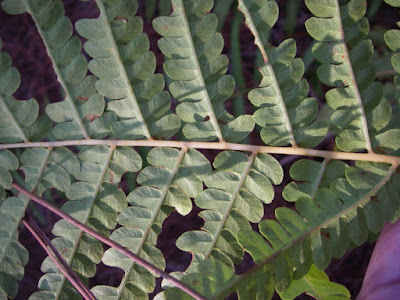
The cinnamon fern displays clustered leaves with pinnately compound fronds that taper towards their outermost tip. These fronds give O. cinnamomea a similar appearance to that of Woodwardia virginica (Wetland plant of the Week #23), however unlike the chain fern, the base of each cinnamon fern leaflet has a small tuft of orange hair that is visible when the undersides of the fronds are examined - pictured in the last image below.

The fern is not the source of the spice “cinnamon,” rather the cinnamon fern gets its common name from the rusty brown colored (i.e. cinnamon-colored) reproductive structures attached to the specialized (spore-bearing) fronds emerging from the center of the plant – pictured in the image below.


A rhizomatous fern, the roots of O. cinnamomea are highly fibrous, black in color and can grow to form a thickly woven mat as the plant matures. These wiry root masses are often harvested for use as planting substrates in horticulture, which is why the United States Agricultural Service lists the cinnamon fern as commercially exploited here in Florida and as vulnerable in New York State.

The specimen above was photographed last week near Goethe State Forest

Tuesday, October 20, 2009

Connecting Carl Sagan, Richard Feynman and Neil degrasse Tyson

Wow… Carl Sagan, Richard Feynman, Neil deGrasse Tyson and… Bill Nye (?) groove to a music track by John Boswell.

Weird, strange, cool, funny, geeky and nerd-tastic...


There’s another one featuring Hawking at http://www.symphonyofscience.com./

Monday, October 12, 2009

Wetland Plant of the Week #29

Agalinis purpurea

Purple False Foxglove

One of twelve Agalinis species found in Florida, the purple false foxglove has widely spreading branches, lacks axillary fascicles and displays corollas longer than 2cm.

A Facultative Wet species with geographic distribution over the eastern half of North America, Agalinis purpurea can be found in hydric pine flatwoods, bogs and seepage areas.


These were photographed last week near Aucilla Wildlife Management Area in northwest Florida.

Tuesday, October 6, 2009

Field Photos: Caster canadensis does some landscaping

While doing some fieldwork in north Florida last week, I stumbled across a small duckweed covered pond. This discovery was unexpected…

It was unexpected because, prior to going to field, I had reviewed aerial photos of the area in hopes of identifying any potential wetlands on site – this pond wasn’t on the aerials.

On closer examination of the pond, I noted that several upland species of trees had recently been inundated by the pond and appeared to be in poor condition; it was a new pond and the trees were being overtaken by the water and slowly drowned…

Then I happened onto direct evidence of the crime and suddenly realized the identity of the culprit!


Looking at the scene, I was reminded of Richard Dawkins’s description of beaver-effects in his book The Extended Phenotype.

I guess that the new pond can be viewed as being the result of rodent genes…

At any rate - and despite the ecological renovations shown above - beavers (Caster canadenis) don’t have quite the impact on the landscape down here in the southeastern United States as they do in more northern regions of the Americas. A recent study published to The American Midland Naturalist examined the affects that beavers have on the landscape in southern Georgia – which is less than 90 miles from where the above images were taken in Florida.

What the scientists found was that lower population densities of beaver in the southeast, in conjunction with the year around availability of food, lessened the intensity of beaver induced impacts.

Brzyski, J., & Schulte, B. (2009). Beaver (Castor canadensis) Impacts on Herbaceous and Woody Vegetation in Southeastern Georgia The American Midland Naturalist, 162 (1), 74-86 DOI: 10.1674/0003-0031-162.1.74

Monday, October 5, 2009

Poor Conservation or Good Business?

(This post has been temporarily removed for revision)


Reiss, K., Hernandez, E., & Brown, M. (2009). Evaluation of Permit Success in Wetland Mitigation Banking: A Florida Case Study Wetlands, 29 (3), 907-918 DOI: 10.1672/08-148.1

Sunday, October 4, 2009

Another Tool in the Exobiologist’s Toolbox

In a recent talk at TED, Garik Israelian describes how spectroscopy may help discover life on other planets…


Thursday, October 1, 2009

Frogs and their Metacommunities

In early August, I published a couple of posts discussing the relationship that existed between biphasic animals and the landscape at large. Of particular interest in those write-ups was the way in which organisms – frogs – traversed the landscape and interacted with different ecological communities. The union that the frogs made between distinctly different types of environments was forwarded as an example of “metacommunity”.

Having loosely defined Metacommunities as a set of distinct ecological communities that are biologically entangled through the spatial dispersion of commonly hosted and interacting species, the focal point of those conversations moved to descriptions of some specific behaviors exhibited by spring peeper and squirrel frogs, and how those behaviors could be interpreted through the metacommunity perspective.

To build on those topics, I wanted to recommend a recently found paper that just happens to discuss metacommunities and our previously encountered friend Pseudacris crucifer, the spring peeper.

The paper - Comparative landscape dynamics of two anuran species: climate-driven interaction of local and regional processes - is available here and is free to view and download.

The research details the unique interactions of frogs with the landscape and undertakes an examination of the vernal pools used by peepers and other chorus frogs during reproduction. Of specific focus is the way in which connectivity between breeding sites is maintained during periods of drought and how the frogs respond to such environmental fluctuations. The paper is worth a read as it looks at both the interactions at the local level, and how those local interactions affect ecologies at the scale of a landscape.

My previous posts on the topic can be found here:

To the Woods and Back Again – A Peeper’s Problem

And Here,

The Metacommunity Mannerisms of Foraging Frogs

Werner, E., Relyea, R., Yurewicz, K., Skelly, D., & Davis, C. (2009). Comparative landscape dynamics of two anuran species: climate-driven interaction of local and regional processes Ecological Monographs, 79 (3), 503-521 DOI: 10.1890/08-1047.1

Wednesday, September 30, 2009

Demonstrating Speciation via Fisherian Runaway

The 1930 publication of Ronald A. Fisher’s eminent work The Genetical Theory of Natural Selection helped pave the way for development of the modern evolutionary synthesis.

[PAUSE]

Actually… If truth-be-told, I’d be inclined to give Fisher’s work a bit more credit for Neo-Darwinism than just “helped pave the way”. Not to shortchange the labors of Huxley, Haldane and the rest of modern biology’s forefathers, but in my assessment Fisher’s linkage of natural selection with genetics was the perhaps the greatest single contribution to the study of evolution since Charles Darwin.

Getting back to the reason for this blog post…

One of Fisher’s many contributions to biology was the idea that through a process of sexual selection, the favored phenotypic traits exhibited by individuals can – if consistently chosen during courtship – increase in frequency and become more numerous in a population, even if the traits offer no fitness advantage.

For example, if the females in a hypothetical bird species happen to find large and colorful feathers attractive, they may choose male birds who display brilliant feathers as their reproductive partners; at least more often than they choose males with dull feathers. Over multiple reproductive episodes, the hypothetical bird population may come to have more-and-more males with brilliant feathers. A greater abundance of colorful males means that competition between males for female access becomes more challenging. The reason for this increase in competition is that the colorful males are no longer competing with just dull feathered rivals, now they find themselves in contest with other brilliants! From the female’s perspective, choosing a mate becomes more tedious, now she must pick not only a male with brilliant feathers, now she must scrutinize each suitor for the brightest and boldest of feathers – the best of the best. This process of increased selection pressure for feather color continues – in a “runaway” process – that culminates with not only a population of birds in which males display brilliantly colored feathers, but even more, the end result is a population that displays larger, more ornate and more colorful feathers; the process compounds and undergoes a positive feedback. All of this due to a female’s mate preference, which she passes on to her female offspring and potentially has nothing to do with fitness (As a side note, this would be a good spot to pitch a previous post Sexual Selection, Good Genes and Condition-Dependent Handicaps).


OK, enough about birds-of-paradise, peacocks or whatever hypothetical bird population I was referring to, the point of all this was to say the following: although the tendency for preferred traits to compound through time has long been observed, it was Fisher that made the connection to genetics. He explained how secondary sexual characters and mating preferences are genotypically bound to mate choice itself. Further, because of the selection pressure levied against secondary sexual characteristics, the potential to sexually isolate a population is ever present; should a new phenotypic variation arise that falls outside the range of female preference, a new species could arise. And, new research published at BMC Biology affirms this Fisherian Runaway dynamic.

From the abstract: This study spotlighted SLa as a novel mate-choice gene in fish. In addition, these results are the first demonstration of a single gene that can pleiotropically and harmoniously change both secondary sexual characters and mating preferences. Although theoretical models have long suggested joint evolution of linked genes on a chromosome, a mutation on a gene-regulatory region (that is, switching on/off of a single gene) might be sufficient to trigger two 'runaway' processes in different directions to promote (sympatric) speciation.


Basically stated, a single gene alteration in a fish changes its color, and the preference for that color by the opposite sex. In turn, this leads to sexual isolation and ultimately a new species…

Fisherian Runaway!


Fukamachi, S., Kinoshita, M., Aizawa, K., Oda, S., Meyer, A., & Mitani, H. (2009). Dual control by a single gene of secondary sexual characters and mating preferences in medaka BMC Biology, 7 (1) DOI: 10.1186/1741-7007-7-64

Tuesday, September 29, 2009

Papilio’s Unconstrained Phenotypic Flexibility

As with most plant feeding insects, butterfly to host-plant adaptations are highly specialized towards specific plant species or plant groups. The reason for this is that plants characteristically produce chemicals that either deter or attract insects based on the defensive and mutualistic needs of the plant itself. Through natural selection, plants adapt specifically to work with (as with pollinators, like bees), or work against, the other organisms cohabitating in their ecosystem. So, if an insect is to take advantage of a plant as a food source it must first adapt tolerances or immunity to the toxic compounds that the plant produces as a defensive measure.


Sanpshot of P. glaucus taken last week in Hamilton Co, Florida. Notice the fine parallel lines of silk beneath the caterpillar; it will use these lines to slowly pull-up the edges of the leaf (Persea palustris, in this case) for protection.


Given enough time, the chemical tolerances of some herbivorous insect populations can become so specialized as to limit their ability to consume other plants; their body chemistry becomes dependent on a single, or only a few, plant species. When evolution pushes an organism’s adaptations to high levels of specialization and thus reduces its ability to be flexible and responsive in a changing environment, we can say that the organism has become “evolutionarily constrained.” This is the case with many species of butterfly, which have adapted resistance to the phytochemicals of only their favorite plants.


Side view of above larvae; the large eyes may be an adaptation to intimidate predators - possibly to look like a snake???


Called monophagy, dependence on a single plant species can leave butterflies vulnerable when environmental conditions change; when once abundant plants become rarer, food becomes harder to find, and fitness declines. Luckily, the evolutionary history of some butterflies may have imprinted sufficient genetic variability in their genome as to provide them a toolbox from which to draw ecological flexibility.

This was a newly emerged P. glaucus photographed in my backyard; it was posted with others during a discussion on ecological divergence (linked below).

Although often demonstrating monophagy, some species of swallowtail butterfly show rather substantial flexibility when it comes to the ability to physically tolerate the phytochemicals of un-preferred plants. To study the ability of Papilionidae (swallowtails) to tolerate different species of plant, researchers from Michigan State placed females of several Papilionidae species into enclosures containing the leaves of one of several plants families. After observing which leaf types the female utilized as a platform for depositing eggs, and after quantifying the larvae’s growth/mortality response relative to the specific plant species provided, the scientists determined that some butterflies exhibit greater ecological flexibility than others.

For example, the MSU study revealed that species such as Papilio troilus could not tolerate the chemicals of plants other than those of the Lauraceae Family, which it has adapted to prefer. Contrastingly, other swallowtail species, such as Papilio glaucus, demonstrated an ability to eat the leaves of several different plant families, even though it displays monophagy in the wild.

NOTE: The Papilio glaucus used in this experiment were harvested form a population found in Levy County, Florida. This particular Florida population had been previously shown to practice monophagy with preference for sweet bay trees (Magnolia virginiana); Ecographica’s prior Wetland Plant of the Week #25. Not to create conflict with my earlier post discussing Ecological Divergence in the Swallowtail, I wanted to clarify that other populations of P. glaucus are “polyphagous” – they use multiple tree species.


Scriber, J., Larsen, M., Allen, G., Walker, P., & Zalucki, M. (2008). Interactions between Papilionidae and ancient Australian Angiosperms: evolutionary specialization or ecological monophagy? Entomologia Experimentalis et Applicata, 128 (1), 230-239 DOI: 10.1111/j.1570-7458.2008.00691.x

Monday, September 28, 2009

Male Sexual Choice; an Uncommon Occurrence

During last Tuesday’s brief discussion on the sexual selection dynamic that exists between male and female barking frogs (Hyla gratiosa), I mentioned that, as a general rule, the female gender of most species are the “deciders” when it comes to choosing reproductive partners. What was meant by this was that females are more-often-than-not the limiting sex in a population and are thus behaviorally better positioned to choose between competing males during the process of sexual selection. Today, I thought that it may be a good idea to give an example of a species that exhibits a mating system typified by reversed sex-roles; one in which males , as opposed to females, are the limiting reproductive resource.

One of the many unique things about Syngnathidae, the biological Family to which pipefish, sea dragons and seahorses belong, is that its female members lay their eggs directly on the trunk or tail of the male gender. Following the ovipositioning that occurs during copulation, the eggs remain bodily attached to the male where they are subsequently fertilized by his sperm. The male then carries the eggs as they develop, providing protection and in some instances even direct nutritional support via circulatory connections to placenta-like tissues contained within his brood pouch (note: not all Syngnathidae males have true brood pouches, in some species the eggs are attached externally to the male’s body in “sockets” that lack circulatory tie).

Because males take on the responsibility of carrying and protecting the clutch, they’re ultimately accountable for the success of the offspring. Fitness measures, such as the number of viable offspring produced from a mating session, are in part determined by the resources allotted by the male to the embryonic development of the piggy-backing eggs. Of course, another significant factor in the fitness potential of offspring is the health and condition of the female whom is contributing the eggs. It is the female’s health and current condition that the male assesses during the initial stages of mate selection.

Although both mating behavior and organismal reproductive physiology differ greatly between individual species of the Subfamilies Hippocampinae (seahorses) and Syngnathinae (pipefish and sea dragons), the process of precopulatory sexual selection is characterized by a courtship dance in which the female entices the male (sometimes for a period of days) through performing elaborate maneuvers, turns, circles and tail holding. If she appears healthy and passes muster – if she’s got the right moves – the precopulatory dance may be followed by mating as mentioned above; the female deposits eggs into the brooding pouch (or, in some species places the eggs on the male’s body).

Incidentally, if you haven’t witnessed the courtship dance of seahorses or pipefish, you are truly missing out on an extraordinary display!!! Check-out this video from the Monterey Bay Aquarium:


In addition to the fitness potential read from the females’ sophisticated chorography, the Syngnathidae males also inspect the female for other visual cues that may provide indication to as to her health, condition and genetic make up.

To better understand the male’s assessment method, Adam G. Jones, Assistant Professor at Texas A & M, examined the preference of male members of the species Syngnathus typhle (a pipefish) for females displaying indicators of high parasite load. As most folks could imagine, large quantities of parasites can affect the overall health of an animal; these freeloaders tap into their host and drink with delight the vital resources acquired through the labors of their target. Even for the pipefish, large quantities of unsightly parasites observable on the exterior of a potential mate are pointers of poor current health. The parasites are literally unsightly; unsightly because that is precisely how the male Syngnathus typhle weighs the female’s appearance – by sight. Should the male perceive large or numerous dark spots on the female, he is far less likely to choose her as a reproductive partner. This is because the dark spots, the male pipefish assumes, are parasites and may adversely affect the condition of any eggs the female may be carrying; therefore black spotted females represent a risky reproductive investment for the male. However, there is one detail that the pipefish in this experiment weren’t privy to, that is that the dark spots in Jones’s study weren’t parasites at all – they were harmless tattoos.

During a recent visit to Tallahassee, Dr. Adam G. Jones explained that the tattooed pipefish experiment was originally intended as an inquiry into the post-copulatory behaviors of Syngnathus typhle. Knowing in advance that males preferentially mated with females showing low parasite loads, Jones had suspected that males of the species may engage in a cryptic choice behavior in order to reduce impregnation by parasite ridden females. Although this experiment ultimately demonstrated no support for the parasite-to-cryptic choice hypothesis, it did exhibit the possibility for cryptic choice along lines other that parasite load, AND the experiment also provided evidence to two key phenomena. Firstly, the experiment revealed that eggs from larger females had a greater statistical tendency to become viable offspring than those received from smaller females. And secondly, the study showed that the first female to mate with the male deposited a larger quantity of eggs than did those females ovipositing afterwards.

So... The natural history of the Family Syngnathidae demonstrates that male choice does exist in the natural world. Further, Jones’s work has shown that male choice extends beyond the precopulatory selection of female mates and that the behavioral ecology of the pipefish even includes post-copulatory mechanisms of sexual selection.


Partridge, C., Ahnesjö, I., Kvarnemo, C., Mobley, K., Berglund, A., & Jones, A. (2008). The effect of perceived female parasite load on post-copulatory male choice in a sex-role-reversed pipefish Behavioral Ecology and Sociobiology, 63 (3), 345-354 DOI: 10.1007/s00265-008-0668-3

Saturday, September 26, 2009

Wetland Plant of the Week #28

Rhexia mariana"Meadow beauty"


One of several meadow beauty species, Rhexia mariana displays a four sided stem, an erect posture and varying amounts of pubescence (small hairs). A perennial and rhizomonous plant, R. mariana is a Facultative Wet species in Florida and can be found residing in bogs and hydric flatwoods Statewide.

A distinctive characteristic of the genus: All of the Rhexia species have a distinctive “urn-shaped” floral tube that encloses their capsulated fruits.


This one was photographed yesterday near Stephen Foster State Park.

Wednesday, September 23, 2009

Fisheries in Peril: The Evolution of Exploitation

What happens when the commercial fishing industry and recreational fishers target certain species for size? Do these practices of selective harvest equate to active artificial selection for smaller fish? Do these practices reverberate in the fish DNA in such a way that humans can be said to be manipulating the evolutionary trajectory of marine life? Thanks to the journal of Evolutionary Applications, here’s your chance to find out!

A few weeks back Loren McClenachan of the Scripps Institution of Oceanography provided an overview of her recent work to the folks at Florida State University - where she’s currently doing some post doc stuff. The bulk of her research centers on the impact that historic human activities have on the populations of fish and marine mammal species. More specifically, using contemporary and historical records such as ship logs, archived photographs, newspaper articles, documented personal accounts, and similar sources, she examines the quantity, geographic distribution and individual sizes of harvested species.

For example, to look at the toll humans have taken on populations of the goliath grouper (Epinephelus itajara) in south Florida, McClenachan ventured to Key West and collected photographs from resident fishing charter services, and historical newspaper articles from the archives at the local county library. Through analyzing the information, she was able to statistically demonstrate (and pictorially illustrate) the change in species composition and individual size of fish harvested recreationally in the Florida Keys. More to the point, she was able to show that between the 1920s and 1970s the maximum size of harvested trophy fish decreased while at the same time the total number of caught fish plummeted.

Photo from McClenachanlen's below cited paper; Grouper Catch Dated 04/14/57


If interested, McClenachan’s grouper paper can be found here:
McClenachan, L. (2009). Historical declines of goliath grouper populations in South Florida, USA Endangered Species Research, 7, 175-181 DOI: 10.3354/esr00167


One has to wonder (i.e. worry) what impact humans are having on fisheries worldwide. Rather it is for recreational or commercial purposes, our fishing actively is reducing the abundance of many marine species, and one can argue that we’re even aggressively and proactively engaging in an artificial selection practice that seems to be in pursuit of smaller fish and reduced species diversity…

I’m reminded of McClenachan’s talk because the journal Evolutionary Applications has just published a special edition which makes available (FREE!) research presented during the 2008 American Fisheries Society Annual Meeting. Anyone with an interest in fisheries, oceanography, ecology, evolution or conservation should take a look – there’s something for everyone!

Included papers (All of which are free - HERE):

Life history change in commercially exploited fish stocks: an analysis of trends across studies (p 260-275)Diana M. T. Sharpe, Andrew P. Hendry


The role of experiments in understanding fishery-induced evolution (p 276-290)David O. Conover, Hannes Baumann


Comparison of demographic and direct methods to calculate probabilistic maturation reaction norms for Flemish Cap cod (Gadus morhua) (p 291-298)Alfonso Pérez-Rodríguez, Marie Joanne Morgan, Fran Saborido-Rey


Is fishing selective for physiological and energetic characteristics in migratory adult sockeye salmon? (p 299-311)Steven J. Cooke, Michael R. Donaldson, Scott G. Hinch, Glenn T. Crossin, David A. Patterson, Kyle C. Hanson, Karl K. English, J. Mark Shrimpton, Anthony P. Farrell


Life-history traits and energetic status in relation to vulnerability to angling in an experimentally selected teleost fish (p 312-323)Tara D. Redpath, Steven J. Cooke, Robert Arlinghaus, David H. Wahl, David P. Philipp


Avoidance of fisheries-induced evolution: management implications for catch selectivity and limit reference points (p 324-334)Jeffrey A. Hutchings


Quantifying selection differentials caused by recreational fishing: development of modeling framework and application to reproductive investment in pike (Esox lucius) (p 335-355)Robert Arlinghaus, Shuichi Matsumura, Ulf Dieckmann


Size-selective fishing gear and life history evolution in the Northeast Arctic cod (p 356-370)Christian Jørgensen, Bruno Ernande, Øyvind Fiksen


Propensity of marine reserves to reduce the evolutionary effects of fishing in a migratory species (p 371-393)Erin S. Dunlop, Marissa L. Baskett, Mikko Heino, Ulf Dieckmann


Implications of fisheries-induced evolution for stock rebuilding and recovery (p 394-414)Katja Enberg, Christian Jørgensen, Erin S. Dunlop, Mikko Heino, Ulf Dieckmann


Mitigating fisheries-induced evolution in lacustrine brook charr (Salvelinus fontinalis) in southern Quebec, Canada (p 415-437)Kenichi W. Okamoto, Rebecca Whitlock, Pierre Magnan, Ulf Dieckmann


Eco-genetic model to explore fishing-induced ecological and evolutionary effects on growth and maturation schedules (p 438-455)Hui-Yu Wang, Tomas O. Höök