Showing posts with label Florida. Show all posts

Sunday, July 31, 2011

What kind of crap is this?

What kind of crap is this anyway?


I’ll give ya a couple hints:

The critter that left it behind lives in Florida, can weigh over 240 lbs, and it is a member of the order Carnivora…

It’s from a Florida Black Bear - Ursus americanus floridanus!

Usually their crap looks a little more like this:


But I guess you never know what you might find when you start digging through another’s crap…

King snake – It’s what’s for dinner!!!

Both of the above pictures were taken near Ft. Walton Beach, Florida a couple of months back.

Tuesday, April 6, 2010

Awesome Picture: Florida Panthers in the Picayune

I was just emailed this picture of a mama panther and her cubs:


The email (from a reliable source) advises that the photo was recently taken during a fly-over of the Picayune Strand near Naples in South Florida.

Looks like three wild Florida panthers - cool!

Also pictured are what looks like a recently cleared road and stands of noxious Melaleuca – could be better! (As a matter of fact it is getting better - click here for info).

In addition to dealing with us ecosystem-altering and land-lusting apes, Florida panthers must also cope with other parasites – including highly specialized trematodes that have evolved a fancy for fare of the feline sort...

Trematodes are flukes of nature (sorry, couldn’t resist) in that they've evolved an astonishing, almost incomprehensible level of developmental plasticity. Most have evolved the ability to subtly manipulate their growth rates and sexual maturation to track the resources available in their environment. For parasitic nematodes, their environment is manifested by the internal chemistry of their victims. Id est, the digestive enzymes, hormones and antibodies expressed through the physiology of their hosts help the trematodes gauge the probability of reproductive success and to tune their own developmental process accordingly. This fantastic capacity for flexibility is of survival benefit because should a trematode happen to find itself immersed in the body of an unsuitable host, it can induce a state of arrested development and shift its metabolism to complete dormancy while awaiting transmission to a more favorable chemical climate. As a natural corollary, if the trematode succeeds in locating its target host (aka, its 'definitive host') it can quickly push development into overdrive and achieve reproductive adulthood in short order, thereby maximizing the opportunity to its individual advantage. Being unrestrained by the ticking-clock of reproductive efficacy, trematodes can migrate from host-to-host and even between species with relative ease. As a case study, consider the misadventures undertaken by the trematode species named Alaria marcianae.


Alaria marcianae is a fascinating organism known to target, as definitive hosts, the kittens of the Florida Panther (Puma concolor couguar). The Florida Panther holds a critically endangered status and, as the common name strongly suggests, resides in the state of Florida. The tawny colored Florida Panther is one variety of a widely recognized group of felids that are also known by the names cougar, mountain lion and puma. The panther-intersecting life cycle of Alaria marcianae is complex with several possible vectors of transmission, but in choosing an arbitrary starting point for the purpose of description, we can assume that its convoluted journey begins within the intestines of an adult panther.

Having recently been deposited in the intestinal tract of an adult feline, members of Alaria marcianae start their lifecycle as eggs. The eggs, unembryonated germ cells, intermix with the partially digested remnants of raccoons, armadillos and other common delicacies found in the panther's system, and are then excreted with the animal's feces. On being submerged in the inundated wetlands for which south Florida – and the Picayune Strand - is renowned, water stimulates the eggs to internally develop embryos. Once these embryos have achieved sufficient maturation, sunlight triggers the eggs to hatch free swimming, cilia-driven, paramecium-looking critters called miracidia.

The miracidia are not adult Alaria marcianae, rather they represent a sexually immature stage of development that is specialized for seeking out a very specific (obligate) intermediate host. To ultimately succeed in stalking a panther, the miracidia of Alaria marcianae must first locate and infect a ram's horn snail of the genus Helisoma.

On locating a ram's horn, the miracidium attaches itself to the soft exposed flesh of the snail, and by excreting tissue-degrading enzymes, it parts ways with its cilia-bearing outer layer. It then penetrates into the snail's body cavity. Shedding its ciliated epithelium, the miracidium becomes an immature sporocyst. Although sporocysts still lack the ability to reproduce sexually, by embedding in the snail's nutrient rich organs they acquire the power to produce additional replicates of themselves - clones called 'daughter sporocysts.'


Further advancing on the panther, the new daughters promptly leave their mother's side and venture to the snail's gonads. Mollusk hormones produced by the gonads fuel special cells within the daughters as they morph into tailed, tadpole-looking larval forms called cercariae. The cercariae swim to, and exit from, the snail's shell-producing mantle. From there, they return once again to the open water as free-swimmers.

Leaving the snail behind, the cercariae swim to the water's surface and hunt down the true tadpoles of the leopard frog (Rana pipiens) - their second intermediate host. Hijacking the leopard frog's tadpoles for transport, the cercariae drop their own tail and burrow into the tadpole's skin. There's no need for self-propulsion when riding inside a tadpole. Once inside the developing frog, Alaria marcianae, then at a stage where they're referred to as mesocercaria, cease further development and undergo another round of asexual cloning. As numbers continue to multiply, they patiently rest, waiting for the tadpoles to carry them landward as adult leopard frogs.

In time, the mesocercaria-bearing tadpoles grow into leopard frogs and move their parasitic cargo to land. On terra firma the leopard frogs are hunted by a wide range of predators; occasionally falling prey to yet another preferred host (aka, a 'paratenic host') of Alaria marcianae, the raccoon. After catching an infested frog, the raccoon's digestive enzymes make short work of the frog's flesh - in the process releasing the mesocercaria. As with its previous host, the mesocercaria multiply in the raccoon, but continue to maintain a state of arrested development - they are not yet adults.

Did I mention that raccoons in south Florida happen to be a favorite prey item of the endangered panther?

Utilizing methods similar to those during the frog-to-raccoon transmission, Alaria marcianae find their way into adult panthers by contaminating raccoons - panther prey. During the process of raccoon digestion, mesocercaria are liberated from tissue and enter the bloodstream by penetrating the intestinal wall.

Now, if the panther they find themselves parasitizing, by chance, turns out to be a lactating female, her hormones will stir the mesocercaria into migrating to her mammary glands where they will transmit (trans-mammary) to the digestive system of her kittens'. The term used to describe the situation in which a mother acts as a paratenic host to her own offspring is called 'amphiparatenesis.'

Here, amphiparatenesis results in the imbibing of mesocercaria-laden milk by the kittens. As with the mesocercaria residing within their mother, the parasites in the kittens will penetrate the intestinal wall and enter the blood stream. They'll surf the blood stream until reaching the lungs where they become metacercaria; as metacercaria they harden the surrounding lung tissue forming protective cysts. Having profitably acquired housing in their definitive host, the cysts in the lungs will eventually be coughed-up the trachea and then promptly swallowed into the esophagus. Once back in the intestines, Alaria marcianae accelerates its developmental process, achieves sexually reproductive adulthood (as sequential hermaphrodites), and deposits the next generation of eggs in the intestine.

Thus the cycle comes full circle.


Reference:
Foster, G., Kinsella, J., Sheppard, B., & Cunningham, M. (2009). Transmammary Infection of Free-Ranging Florida Panther Neonates by Alaria marcianae (Trematoda: Diplostomatidae) Journal of Parasitology, 95 (1), 238-239 DOI: 10.1645/GE-1749.1

Tuesday, March 30, 2010

The Views of Biology Teachers towards Teaching Evolution

In discussing Marco Rubio’s anti-science perspectives during the previous post, I mentioned Florida’s miserable (though improving) track record in regards to the teaching of evolution. As it turns out, the National Association of Biology Teachers has recently published the results of a survey which focused on the attitudes held by Florida’s biology teachers towards the teaching of evolution.

The survey’s data was derived from the responses of 353 Florida biology teachers; 28% of which taught biology in kindergarten through the fifth grade, 24% instructed biology in grades six through eight and 48% taught biology at the high school level (grades 9–12).


A Few of the Findings:
20% of Florida’s biology teachers are NOT COMFORTABLE with even INCLUDING evolution as a required science standard


17% of the teachers felt that biology COULD be taught and understood WITHOUT teaching evolution


17% DISAGREED that the earth is at least 4 billion years old (34% of those that disagreed believed that the earth is only between 4,000 and 40,000 years old)


34% felt that believing in God MEANS rejecting evolution


72% of the respondents reported that they HAD NEVER BEEN criticized by other teachers or school administrators in regards to HOW they taught evolution


44% of the teachers indicated that their teaching of evolution HAS BEEN criticized by students or parents


If the above numbers seem frightening consider this: The study’s respondents were solicited from the Building a Presence in Science (BaP) program of the National Science Teachers Association. Therefore, the numbers could be biased towards the "pro" science education end of the spectrum!!!


FOWLER and MEISELS (2010). Florida Teachers’ Attitudes about
Teaching Evolution The American Biology Teacher, 72 (2), 96-99 : 10.1525/abt.2010.72.2.8

Saturday, July 25, 2009

The Diamondback Rattlesnake’s Predatory Might

A new project at work has kept me in the field for the last couple of weeks and has severely dimensioned my time available for blogging; I should be freed up by the middle of next week and be able to get Ecographica back in gear then…

On the positive side of things, the abundance of recent fieldwork has resulted in several encounters with nature, and a slow starting Saturday has provided the opportunity to share one such wildlife sighting. However, before proceeding a warning must be forwarded; if you are lucky enough to stumble onto one of these herps in the wild, ensure that you’re stumbling is undertaken with the utmost caution – or your luck may run out very quickly! Although the below video and picture appear to be taken at close range, they in fact have been recorded at a distance and later edited from the safety of a desk.

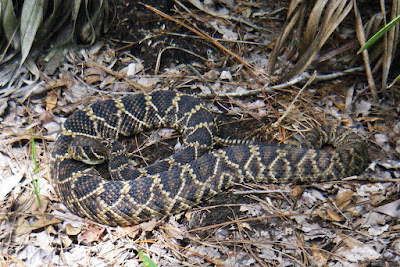
Getting on with the tale (or, in this instance “tail”), while trudging through a chunk of palmetto flatwoods in north central Florida last week, a break in the radiating palmetto leaves underfoot caught my eye – a diamondback rattlesnake! And a big one at that!

Photo was taken by Charlie, a fellow ecologist that happens to be a little faster at drawing his camera.


The eastern diamondback rattlesnake Crotalus adamanteus is the largest pitviper in the Western Hemisphere and can achieve sizes (length) of more than seven feet. Fairly common here in Florida, their range extends north along the Atlantic seaboard to the Carolinas and westward to about New Orleans, Louisiana. They do well in habitats such as palmetto flatwoods due to the ample cover provided by the palmetto leaves (“palmetto” = Seronoa repens).

The leaves provide shade for regulating body temperatures, conceal them from fumbling ecologists, and offer excellent camouflage for setting ambushes – and setting ambushes is what they do best. They lay in wait for hours, motionless; then, when the radiating heat of an approaching rabbit, bird or other delicacy enters into range, OR when a savory molecule lands on the flicking tongue (vomeronasal organ or “Jacobson’s organ”), STRIKE!

Strike indeed! Strike with the largest fangs of any rattlesnake species and with a venom pact-full of proteins adapted to produce hemorrhaging and tissue necrosis.

Here's a quick video of the same specimen. He's on the move, so I paused the video a couple of seconds at the start; his head is near the upper right-hand corner - look for the curser.


Although the food capturing mode of Crotalus adamanteus can easily be described as “predatory,” their relative contribution, or “predatory influence,” within ecosystems is not especially clear. Typically, when viewing a system’s predator-prey functionality the response and feedback between prey availability (how many are present) is weighed against the number of predators acting antagonistically within the system.

For example, one question that could be posed in regards to the predator function of Crotalus is “how does a surge in rabbit numbers (prey) affect the longevity and reproductive success (population) of the eastern diamondback?” This may seem pretty much straight forward, however; the ability of reptiles to control or impact prey populations within a given environment may be somewhat different than those of endothermic predators; after all, the biology and physiology of ectotherms is considerably different – they posses a different metabolic scheme altogether.

In examination of predator function within the Viperidae (the Family to which the eastern diamondback is a member), Erika Nowak of the US Geological Survey and others concluded that in comparison to predator-prey models established for mammals, the ectothermic vipers contribute a lesser prey population regulating potential.

The reasons for the Viperidae’s decrease in predator functionality include:
1. Longer prey handling times due to a comparatively limited digestive capability
2. Increased tolerances for fasting
3. An increased ability to convert food into fitness currency (progeny)
4. A limited ability for rapid reproductive tracking of short-term prey abundance.

Their article (Functional and Numerical Responses of Predators: Where Do Vipers Fit in the Traditional Paradigms?) Strongly points to the need for additional research in several areas behavioral ecology. I fully agree with this assessment, but for whosoever takes on the task - watch your step!


Erika M. Nowak1, Tad C. Theimer, Gordon W. Schuett (2008). Functional and Numerical Responses of
Predators: Where Do Vipers Fit in the
Traditional Paradigms? Biological Reviews, 83 (4), 601-620

Thursday, April 16, 2009

Anti-Science and Ignorance Prevail – No on Stem Cell Research

State funding for embryonic stem cell research falls to the wayside at the State’s Capital today as Reps put politics and ignorance before science, ethics and public health during a debate at the Florida State University…

Rep. Eric Eisnaugle oppossed the research because his mommy said so…
“As much of a stake she has in this, she is absolutely against using public money to fund embryonic stem cell research,” said Eisnaugle.


And Miami Representative Anitere Flores decided to make a “definitive statement” in hopes of promoting misinformation and avoiding ethical challenges. Read her letter to Science and Ethics Chair Claire Thuning-Roberson - here.


Their arguments are as baseless and ignorant as the positions themselves.

Absolutely shameful, welcome to the south ya’ll !

Saturday, March 28, 2009

The Rise of “Homo egocentricis”

Although it was literally a dark and stormy night, such weather conditions were but a novelty to the speaker – a scientist whom had spent the majority of his life scanning barren rocks and desiccated landscapes for fragments of fossil bone beneath the unrelenting and scorching sun of an East African desert. Yet, I can’t help but think that some level of instinctual fear naggingly tickled at his stomach as he approached the waiting crowd…

There was little doubt that villains - the arch enemies of reason and deniers of fact– concealed themselves among the many upstanding community members and university staff in attendance. This was, after all, Tallahassee, Florida. A city of the Southeastern Unite States, geographically located near the eastern extent of the so called “Bible belt.”

How would they react to being told that biological evolution is fact? Moreover, how would they respond to learning that Homo sapiens, despite an egocentric view of the world, have shared a common ancestry with other primates, and in fact, a common lineage with all life on Earth?

Actually, they responded remarkably well, much to the credit of Dr. Don Johanson.

By all accounts, the talk on Human Origins was a success. Dr. Johanson spoke with the confidence and familiarity that has made him a highly sought, world renowned lecturer and scientist.


He began the talk by discussing the development of his personal interest in anthropology as a child and quickly moved through a summary of the major fossil discoveries made during his lifetime - a true story of adventure and discovery. The lecture was given at an IMAX theater and included some fantastic images of hominid fossils and African landscapes; the presentation can be viewed in its entirety by going to the FSU Origins webpage HERE and clicking on the red-highlighted “Webcast” text to the right of Dr. Johanson’s photograph.

As a further suggestion, I’d recommend a quick look at a recent article by Kaye E. Reed of the Institute of Human Origins (which Don Johanson runs in Arizona) discussing the paleoecology of the Hadar hominin site in Ethiopia. The article discusses speciation and environmental transitions associated with Australopithecus afarensis.

Reed, K. (2008). Paleoecological patterns at the Hadar hominin site, Afar Regional State, Ethiopia Journal of Human Evolution, 54 (6), 743-768 DOI: 10.1016/j.jhevol.2007.08.013

Saturday, January 31, 2009

Jumping spinner shark caught on video

Jumping spinner shark caught on video here in Florida.