Showing posts with label Wetland Plant. Show all posts

Monday, December 28, 2009

Wetland Plant of the Week #39

Hydrocotyle verticillata

Shield Pennywort

Shield pennywort represents but one of about a hundred different species that belong to the Genus Hydrocotyle, a.k.a the ‘water pennyworts.’ Though often found listed as members of the Apiaceae Family, the Hydrocotyle group is now included in the ‘Ivy Family’ (Araliaceae). The genus as whole enjoys a worldwide distribution; however, the Facultative Wet H. verticillata is native to the Americas where can be found occupying floodplains, swamps, ditches, and just about anywhere with moist soils.


A perennial herb, shield pennywort is often found growing in dense mats or even rafting on open water. The rounded leaves (orbicular) leaves can grow up to 6cm in diameter and are crenate at the margin. The five-petaled flowers of Hydrocotyle verticillata are white-to-green in color and cluster together in umbels.

The above photos were taken a couple of weeks back near Panama City, Florida.


CHANDLER, G., & PLUNKETT, G. (2004). Evolution in Apiales: nuclear and chloroplast markers together in (almost) perfect harmony Botanical Journal of the Linnean Society, 144 (2), 123-147 DOI: 10.1111/j.1095-8339.2003.00247.x

Sunday, December 20, 2009

Wetland Plant of the Week #38

Iva frutescens “Marsh Elder”

Marsh elder is a perennial, multi-branching shrub that is native to the coastal regions of the southeast United States. It can typically be found inhabiting the ecotones surrounding saltwater and brackish marshes, as well as in the wetland transitional zones associated with the coasts of the Atlantic Ocean and Gulf of Mexico. Though an Obligate species, Iva frutescens has a reduced tolerance for long periods of inundation; this is why it’s found in ecotone areas as opposed to more marsh-centralized localities.


The succulent lanceolate leaves of Iva frutescens maintain a dull green color year around and exhibit an opposite arrangement. The margins of the leaves often display a serrate edge and/or have few sporadically placed teeth. The plant’s green flowers can be found clustered on panicles and appear as a ‘drooping head.’ The fruiting bodies of Iva frutescens exists as oval shaped, dark brown achenes.

The morphological characters displayed by the marsh elder’s achenes demonstrate adaptation to an aquatically driven mechanism of dispersal. The achenes are only about 2mm in length and have a very smooth outer covering; this makes them ideally suited for transport via water. Known as hydrochory, water facilitated seed transport is a strategy that is implemented by a large number of coastally located plant species. In regards to the lineage of Iva frutescens specifically, proximity to tidally influenced waters has selected achenes with a tolerance for saltwater and a proven ability to stay afloat while in a non-dormant condition. In fact, research published just this year has shown that the achenes of Iva frutescens can stay afloat for more than 67 days – that’s pretty impressive. These physiological adaptations have paid large dividends for the marsh elder, as they can be found in abundance from the Gulf Coast of Texas northward along the US shoreline to Canada.


Elsey-Quirk, T., Middleton, B., & Proffitt, C. (2009). Seed flotation and germination of salt marsh plants Aquatic Botany, 91 (1), 40-46 DOI: 10.1016/j.aquabot.2009.02.001

Monday, December 14, 2009

Wetland Plant of the Week #37

Helianthus angustifolius

Swamp Sunflower

Helianthus angustifolius is a branched perennial plant that is native to North America. This Facultative Wet species can found in hydric flatwoods and marsh communities as well as along the sides of ditches and roads that have mesic to saturated soils. Its brilliantly colored disk flowers make it easily recognizable as a member of the Asteraceae’s sunflower group – the Genus Helianthus. The swamp sunflower’s tall domesticated cousin, ‘the’ sunflower Helianthus annuus, is cultivated the world over for its nutritious seeds, oils and aesthetic value.

The swamp sunflower lacks rhizomes, and loses its basal leaves during the flowering season. The leaves of the lower stem are lanceolate in shape and transition from an opposite arrangement on the lower stem to an alternate one towards the top. The flowers of Helianthus angustifolius are either yellow or purple in color.


The Helianthus genus as whole is widely used to study diploid and polyploid speciation dynamics in plants. Helianthus angustifolius itself is typically phylogenically grouped with the species H. simulans and H. floridanus. All three sunflowers share common morphological features and have overlapping ranges (southeastern United States); however, only H. angustifolius will successfully cross with both H. floridanus and H. simulans.


The above plant photos were taken a couple of weeks back in the Florida Panhandle. The close-up with the lynx spider was featured with several other swamp sunflower pics in the prior post The Tactics of an Egg Tending Lynx.


As an administrative note, in the event that you’re tracking the Wetland Plant series, I’ve recently discovered that there’s been a miscount – I published two different posts with plants designated as Wetland Plant of the Week #25. To correct for this error this post has been numbered 37, but falls in line after Wetland Plant # 35.


TIMME (2007). HIGH-RESOLUTION PHYLOGENY FOR HELIANTHUS American Journal of Botany, 94 (11), 1837-1852

Saturday, December 5, 2009

Wetland Plant of the Week #35

Aronia arbutifolia

Red Chokeberry

The red chokeberry is a medium sized shrub displaying minimal branching, gray bark and alternately arranged leaves. It’s one of two species of Aronia found in the eastern United States; the other species being the black chokeberry (A. melanocarpa). Aronia arbutifolia is common to stream banks, seepage slopes and hydric flatwoods that possess sufficient water to satisfy the plant’s Facultative Wet habitat preference. The leaves of the plant have a visible gland at the tip, a toothed margin and small red or purple spots along the midrib. The white-to-pink flowers emerge in spring and exhibit five petals. In addition to the attractive flowers, the aesthetically pleasing bright red berry-like fruits of Aronia arbutifolia have made it popular with horticulturalists as an ornamental.


Aronia arbutifolia is one of about 3000 species included in the Rosaceae Family. Despite the rose family’s general familiarity with both botanist and non-botanist alike, the group’s phylogeny is not understood all that well. Our current understanding of the Aronia Genus is in large part derived from the sequencing of several nuclear and chloroplast loci back in 2007. That study placed the chokeberries in the Maloideae subfamily. This Maloideae subfamily also contains the genus Malus (crab apples) and for that reason is sometimes referred to as the “apple group.” Although resolution of the group’s phylogeny has somewhat improved since then there is still plenty of work to do in understanding their evolutionary past.

The plant photo was taken two weeks ago near Panama City, Florida.


Potter, D., Eriksson, T., Evans, R., Oh, S., Smedmark, J., Morgan, D., Kerr, M., Robertson, K., Arsenault, M., Dickinson, T., & Campbell, C. (2007). Phylogeny and classification of Rosaceae Plant Systematics and Evolution, 266 (1-2), 5-43 DOI: 10.1007/s00606-007-0539-9

Sunday, November 29, 2009

Wetland Plant of the Week #34


Limonium carolinianum

Sea Lavender

Despite its common name ‘sea lavender’ is a member of the Plumbaginaceae Family, which means that it isn’t really a ‘lavender’ at all, as lavenders belong to the Lamiaceae Family. One of the plant’s unique characteristics is that it’s one of only a handful of the Limonium genera’s 120 species with a range limited to North America; the majority of the genera’s members show a much more global distribution. Here in Florida, the Obligate can be found near saltwater or brackish marshes, or as with the one in the above photo, in mangrove swamps.

Limonium carolinianum is an herbaceous perennial with a woody rhizome and alternating leaves. The leaves themselves are basal, generally elliptic in shape and have a leathery feel when touched. The flowers display five stamens, and a five-lobed, whitish colored calyx with a corolla that ranges from blue to lavender. The fruits of the sea lavender bear a single maroon colored seed, which as with the plant’s range mentioned above, represent another unique characteristic. More specifically, the seeds’ morphology and structure have undergone adaptation as to tell-the-tale of plant’s favored mode of geographic conquest.

The brownish-red seeds of the sea lavender are relatively large and display a sheen that likely attracts birds. The plant’s habitat preference for saltwater proximal real-estate when combined with the sheen displayed by its seeds may work cohesively to facilitate dispersal of its genome. As Charles Darwin pointed out on page 361 of the Origin of Species,

“Living birds can hardly fail to be highly effective agents in the transportation of seeds.”

This is likely true of Limonium carolinianum, a plant species that has adapted to near-sea environments that are frequented by shore birds.


Biologically assisted seed dispersal mechanisms can be thought of as primarily working along one of two primary lines. One method of dispersal, called epizoochory, relays on seeds being externally attached to the hair, fur or feathers of animals. Once attached, the seeds are carried with the animal as it moves across the landscape. The second mode of animal derived seed transport is called endozoochory; in this instance the seeds are eaten by an herbivore or frugivore and then deposited elsewhere with the animal’s feces.

Although the possibility of water facilitated seed dispersal is not ruled-out, the seed morphology of Limonium carolinianum increases the plausibility for endozoochory.


FIGUEROLA, J., & GREEN, A. (2002). Dispersal of aquatic organisms by waterbirds: a review of past research and priorities for future studies Freshwater Biology, 47 (3), 483-494 DOI: 10.1046/j.1365-2427.2002.00829.x

Saturday, November 21, 2009

Wetland Plant of the Week #33


Hypericum fasciculatum “Peelbark St. Johnswort”

Peelbark St. Johnswort, also known as ‘marsh St. Johnswort,’ is a Florida native and widely distributed member of the Hypericaceae Family that can commonly be found in swamps, marshes and just about any locality having sufficient water to satisfy its Obligate lifestyle. The multi-branched growth pattern of this upright shrub gives it a very bushy appearance, and provides ample structure for numerous arthropods species to nest and hide (including ticks, take caution).

Though typically about four feet tall, the woody stems of Hypericum fasciculatum can push the plant upwards to reach heights of over two meters (6ft). In an effort to increase available surface area for oxygen absorption, the reddish-bark of the stems is exfoliated giving it a soft and crumbly look and feel.


The needle-like leaves of the plant grow in bundles and average about 2.6cm in length with slightly longer leaves at the top of the stem. The flowers, although not pictured here, display five petals arranged in a whorled pattern and can be found spring-through-summer at the terminal ends of the branches.


The abundance of Hypericum fasciculatum, when combined with its multi-branched physiognomy and its habitat preference for plentiful water, make the plant an integral component of aquatic ecosystems here in Florida. As mentioned previously, the structure provided by the plant’s branches, branchlets and leaves attract a myriad of arthropod species. Once attracted by the ‘peelbark,’ these same arthropods will, in turn, move to occupy niches in proximity to the plant. There they’ll take on roles as pollinators, predators and prey for other organisms. Through such species interactions, the trophic effects of seemingly unconnected organisms become intertwined and bound.

As an example of how complex life histories can become tangled, consider for a moment a hypothetical swamp in which a hypothetical fish is swimming around the exfoliated base of a hypothetical Hypericum fasciculatum …

As with many fish, the hypothetical one feeds on aquatic insects like water beetles, mayflies and larval dragonflies. Examining dragonflies in particular, the loss of dragonfly larvae via fish predation ultimately results in the emergence of fewer adult dragonflies than would be predicted in the absence of the fish. Compounding the process further, the presence of fewer adult dragonflies in nearby ecological communities translates to less aerial predation of flying insects. Flying insects, in addition to being food-stuffs for dragonflies, also pollinate plants; from this relationship it can be inferred that with fewer dragonflies, more insect pollinators find the nectar-rich flowers they seek… The end result of this hypothetical situation is that the Hypericum’s proximity to the fish allows the plant to host a greater number of pollinators, and thus to experience a greater level of reproductive success itself.

Image from Cited Article, interaction web showing the pathway by which fish facilitate plant reproduction. Solid arrows ndicate direct interactions; dashed arrows denote indirect interactions. The sign refers to the expected direction of the direct or indirect effect.


As is characteristic of most ecosystem dynamics, the above scenario can also be run in reverse to show that the presence of the common Hypericum fasciculatum could lead to increased fitness in the hypothetical fish species.


Knight, T., McCoy, M., Chase, J., McCoy, K., & Holt, R. (2005). Trophic cascades across ecosystems Nature, 437 (7060), 880-883 DOI: 10.1038/nature03962

Friday, November 13, 2009

Wetland Plant of the Week #32

Aster carolinianus

Climbing Aster

Climbing aster, unlike the majority of the other varieties in the genus (which are herbaceous), presents as a many branched shrub with a woody stem base and often even woody branches. The Obligate plant displays numerous leaves that range from elliptic to lanceolate in shape. The flowers are typically about an inch in diameter and generally have a light-blue or light-purple color.

Aster carolinianus is native to the coastal plain of the southeastern United States and is often found residing in marshes, along stream banks and - as pictured above - in freshwater swamps.

As a characteristic trait, the climbing aster has the habit of entangling itself in the branches of surrounding plants, or even tying itself in large tousled masses.


Asterales, the order to which the Asteraceae family belongs, has origins in the Cretaceous period about 100 million years ago and probably experienced diversification during the Oligocene and Miocene. In regards to their evolutionary past, recent research by Tom Viaene (et al) examined the variability of stamen and petal morphologies within the basal asterid families. Through comparisons of the genes that coded for these floral structures, he determined that the early members of the asterid group likely duplicated the petal and stamen genes as a strategy for moving into a wider range of niches.

The above images were taken last week near St. Marks National Wildlife Refuge in northern Florida.


Viaene, T., Vekemans, D., Irish, V., Geeraerts, A., Huysmans, S., Janssens, S., Smets, E., & Geuten, K. (2009). Pistillata--Duplications as a Mode for Floral Diversification in (Basal) Asterids Molecular Biology and Evolution, 26 (11), 2627-2645 DOI: 10.1093/molbev/msp181

Thursday, November 5, 2009

Wetland Plant of the Week #31

Polygala rugelii“Milkwort”

Members of the Polygalaceae Family can be found the world over, with representatives of the Genus Polygala taking credit for at least half of the total species in the group (Polygala spp. account for about 500 of the 1000 species in the family). Known commonly as “milkworts,” about 23 of the species can be found in Florida, including Polygala rugelii pictured above.


Polygala rugelii displays an irregular basal rosette with spatulate leaves, and bright yellow flowers that are arranged in dense racemes. Like all – except one - Floridian Polygala, P. rugelii is a Facultative Wet plant that has adapted to thrive in hydric flatwoods, seepage slopes and savannas (note: P. Cymosa is the only non-Facultative Wet species in Florida – It’s an Obligate).


This one was photographed about two weeks ago near Yankeetown Florida.

Sunday, October 25, 2009

Wetland Plant of the Week #30

Osmunda cinnamomea

“Cinnamon Fern”

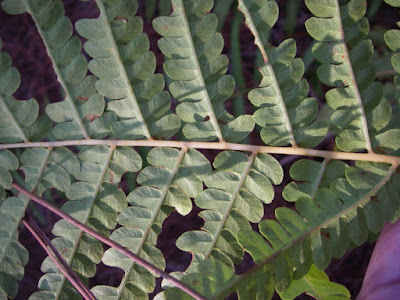
The cinnamon fern displays clustered leaves with pinnately compound fronds that taper towards their outermost tip. These fronds give O. cinnamomea a similar appearance to that of Woodwardia virginica (Wetland plant of the Week #23), however unlike the chain fern, the base of each cinnamon fern leaflet has a small tuft of orange hair that is visible when the undersides of the fronds are examined - pictured in the last image below.

The fern is not the source of the spice “cinnamon,” rather the cinnamon fern gets its common name from the rusty brown colored (i.e. cinnamon-colored) reproductive structures attached to the specialized (spore-bearing) fronds emerging from the center of the plant – pictured in the image below.


A rhizomatous fern, the roots of O. cinnamomea are highly fibrous, black in color and can grow to form a thickly woven mat as the plant matures. These wiry root masses are often harvested for use as planting substrates in horticulture, which is why the United States Agricultural Service lists the cinnamon fern as commercially exploited here in Florida and as vulnerable in New York State.

The specimen above was photographed last week near Goethe State Forest

Monday, October 12, 2009

Wetland Plant of the Week #29

Agalinis purpurea

Purple False Foxglove

One of twelve Agalinis species found in Florida, the purple false foxglove has widely spreading branches, lacks axillary fascicles and displays corollas longer than 2cm.

A Facultative Wet species with geographic distribution over the eastern half of North America, Agalinis purpurea can be found in hydric pine flatwoods, bogs and seepage areas.


These were photographed last week near Aucilla Wildlife Management Area in northwest Florida.

Saturday, September 26, 2009

Wetland Plant of the Week #28

Rhexia mariana"Meadow beauty"


One of several meadow beauty species, Rhexia mariana displays a four sided stem, an erect posture and varying amounts of pubescence (small hairs). A perennial and rhizomonous plant, R. mariana is a Facultative Wet species in Florida and can be found residing in bogs and hydric flatwoods Statewide.

A distinctive characteristic of the genus: All of the Rhexia species have a distinctive “urn-shaped” floral tube that encloses their capsulated fruits.


This one was photographed yesterday near Stephen Foster State Park.

Wednesday, September 16, 2009

Wetland Plant of the Week #27

Sarracenia minor

"Hooded Pitcher Plant"

As with Sarracenia leucophylla and Sarracenia flava (Ecographica’s Wetland Plants of the Week numbers 24 and 25), the hooded pitcher plant is an Obligate, insectivorous member of the Sarraceniaceae Family that has evolved highly specialized leaves that are capable of capturing invertebrates. Native to Florida, this perennial plant displays yellow to yellowish-green flowers and leaves that are around 26 centimeters in length. One leaf – the hood – has adapted in such a way to overlap the cupped base of the plant, forming a "hood".

As with the above mentioned Sarraceniaceae, this plant loves wetlands, but demonstrates a greater tolerance for mesic environments than does the other two.


These were photographed in the Osceola National Forest a couple weeks back.

Friday, September 4, 2009

Wetland Plant of the Week #26

Dichromena colorata

"White-Top Sedge"

White-top sedge, or star rush, is an herbaceous perennial plant with linear erect leaves and slender tubular stems. The flowers of Dichromena colorata are white with two stamens and no perianth; they can have three to ten bracts. A member of the Cyperaceae and a Facultative Wet species, star rush is found throughout Florida.


This one was photographed on Wednesday near Wildwood, Florida.

Friday, August 7, 2009

Wetland Plant of the Week #25


OK, maybe the workload has dissipated enough to drop a couple of posts here at Ecographica…

To get back things back on track, let’s first get caught-up with the Wetland Plant of the Week. Back in early July we left off with Sarracenia leucophyll, the white top pitcher plant, so let’s start there with another species of Sarracenia, the “trumpet-leaf pitcher plant.”


Sarracenia flava

Trumpet leaf pitcher plant

The trumpet-leaf, like the white top, is an insectivorous plant in which the leaves have adapted to form a “cup” capable of holding water. The trumpet-leaf has yellowish green pitcher leaves and hoods with a maroon colored interior neck. The hood stretches over the mouth of the “pitcher cup” but does not completely close it. The flowers are yellow in color, solitary and persistent. This pitcher plant is an Obligate species and is found in bogs and wet savannas.


This one was photographed near Panama City last Wednesday.

Sunday, July 5, 2009

Wetland Plant of the Week #24

Sarracenia leucophylla


White top pitcher-plant

The white top pitcher-plant is an Obligate insectivorous member of the Sarraceniaceae Family. It displays alternate and erect green leaves with the upper most tubes/hoods colored white with purple veination; the flowers are dark red or maroon in color.

These were photographed last Thursday in Bay County, near Point Washington Wildlife Management Area.

Wednesday, July 1, 2009

Wetland Plant of the Week #23

Woodwardia virginica

"Virginia Chain Fern"

Chain ferns are Facultative Wet members of the Blechnaceae Faimily. Their leaves are bright green and display a characteristic "chain like" venation pattern on each pinnule. They are deciduous ferns with an affinity for acidic wetlands with plenty of sphagnum in the groundcover.

These were photographed a couple of weeks back near Big Shoals State Park in Florida.

Saturday, June 20, 2009

Wetland Plant of the Week #22


Osmunda regalis

Royal fern


The royal fern is an Obligate member of the Osmundaceae Family, they have thick creeping rhizomes and roots that are black, wirily and clump into large masses. Leaves are bipinnately compound with alternating leaflets and display finely toothed margins.

This one was photographed about a week ago near the Suwannee River in Columbia County, Florida.

Saturday, June 13, 2009

Wetland Plant of the Week #21

Gordonia lasianthus

Loblolloy Bay

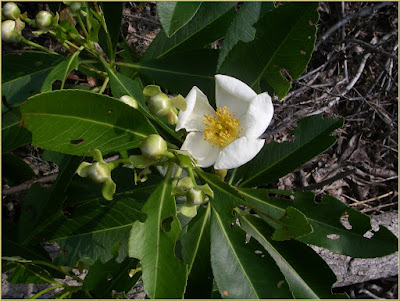
Facultative Wet, evergreen tree with alternate, leathery leaves with toothed margins; the lower sides of leaves are a shade of green lighter than that on the top surface. As shown in the picture, the flowers have five petals and display numerous yellow stamens at center.

This one was photographed earlier this week near Big Shoals State Park in Florida.


Saturday, June 6, 2009

Wetland Plant of the Week #20

Baccharis angustifolia

Saltwater false willow


Baccharis angustifolia is an Obligate perennial shrub and member of the Asteraceae Family; it displays erect slender stems with narrow, single veined, succulent leaves that alternate. Saltwater false willow can commonly be found near the Atlantic and Gulf coastal plains.

This one was photographed two weeks ago near the Chassahowitzka National Wildlife Refuge.

Friday, May 29, 2009

Wetland Plant of the Week #19

Borrichia frutescens

Sea-Oxeye

Sea Oxeye is an Obligate member of the Asteraceae family and is native to salt water wetlands in Florida, the Bahamas, and the Caribbean. Often found in and around Mangroves, its fleshy gray-green leaves and large yellow composite flowers make it easy to identify.

I photographed this one yesterday near the Chassahowitzka National Wildlife Refuge.