




Showing posts with label Predation. Show all posts

Sunday, March 21, 2010

Tadpole Tails and Predator Induced Plasticity


Last Wednesday, while doing field work near Goethe State Forest, I happened onto the paths of a couple pinewoods tree frogs (Hyla femoralis). One frog was observed practicing evasive acrobatic skills between the leaves of a saw-palmetto dominated groundcover; the second frog, taking a more leisurely approach to the day, was found lazily stretched out on mid-swamp tree branch. Because of a recent environmentally-induced neglect of this blog on my part, I thought that the two frogs would serve as a good model for a post on how tadpoles can alter their developmental physiology in response to local ecological conditions.


Like many other frogs, the pinewoods tree frog undergoes a complex life cycle which carries them from the ephemeral waters of ponds, swamps and puddles to an adulthood existence in the trees. In response to the variability of selective pressures expressed by their environments, natural selection has shaped Hyla femoralis in such away as to be flexible. One example of this flexibility is the way in which their tadpoles can alter phenotype – their morphology - in response to the presence of predators. As opposed to their developmental processes rigidly rendering tadpoles displaying uniform and unchanging morphologies, the DNA of flatwoods tree frogs has been programmed to make size, growth rate and coloration malleable characteristics. The ability of an organism to change its physical characteristics to better fit local conditions is called ‘developmental plasticity.’

In addition to normal variations encountered at the regional level, or within individual populations, the colors and shapes exhibited by tadpole tails can differ from one location to another; this is because tail characteristics can be changed in response to cues in the environment. In waters lacking abundant predators, Hyla femoralis tadpole tails are generally colorless, or are of a dull brownish-red color. In contrast to relatively safer waters, the tadpoles hosted by puddles with abundant predators (predators like dragon fly larvae, for example) are often found bearing tails with distinct red-spot markings and an enhanced, taller shape and muscular robustness. Increased tail muscle provides greater propulsion, allowing the tadpoles to employ accelerated speeds as part of their predator evasion tactics. Though, it’s still an area for inquiry, changes in the pattern and coloration of tails may provide a crypsis function by either providing improved camouflage, or by directing predatory attacks tail-ward, away from the tadpoles’ main body mass – improved survival through either concealing or revealing.

The chemical signals that switch tail enhancement into overdrive include those compounds released by other tadpoles as warning pheromones during predatory attack and those molecules discharged by the predator while digesting prey-tadpole tissues. So, in other words, a predator’s attack and digestion of a conspecific tad liberates chemicals into the water that are received by other tadpoles during development; as a result, resources are directed away from ‘normal’ growth processes and are directed to tail augmentation.

Cool stuff!

A couple quick notes:

Pinewoods tree frogs display distinct orange or yellow spots on their inner side of their thighs, while in the field these spots help distinguish Hyla femoralis from other species with similar body color patterns. Though not pictured here, the leg spots were observed during the frogs’ recent attempts at evading a certain species of primate paparazzi. Their tadpole stage lasts for about two months, and the breeding season begins in March and runs through the summer months.

Although cypress swamps and pine flatwoods are distinct natural community types, they are both occupied by the pinewoods tree frog. The first snapshot above shows one Hyla femoralis precariously perched on the stem of a saw palmetto plant just a few inches off the ground in a well-drained upland flatwoods area. The second shows another individual leisurely laying on a tree branch about five feet above the surface waters of a swamp. In Florida, these communities are often directly adjacent to each other:


LaFiandra, E., & Babbitt, K. (2004). Predator induced phenotypic plasticity in the pinewoods tree frog, Hyla femoralis : necessary cues and the cost of development Oecologia, 138 (3), 350-359 DOI: 10.1007/s00442-003-1412-3

Wednesday, October 28, 2009

Venomous Fables and Phenotypic Variations at the Molecular Level

Remembered for both his lucid writing ability and his tedious nature, the Greek historian Herodotus has often been criticized for the habit of adding unnecessary embellishment to his otherwise candid historical accounts. Focused primarily on the Greco-Persian Wars and personal travels around the Mediterranean, Herodotus’ works also included – on occasion – particulars that many of his 5th Century B.C. contemporaries considered questionable.

One such questionable account from Herodotus centered on the life of a certain Phrygian slave with a knack for composing short prose. Not quite Shakespearian in character, the prose rendered by this slave usually involved references to anthropomorphized wildlife and included a take-home moral message. Now typically, writing prose or verse is a rather benign enterprise, particularly when writing stories about personified animals. Moralizing on the other hand… Moralizing can sometimes get you in trouble, and regrettably for the Phrygian slave, trouble was precisely the result of his high-minded allegories - he was reportedly thrown from a precipice in Delphi for being ugly and “offensive.”

Modern historians raise doubt as to the veracity of Herodotus’ accounts of the Phrygian slave. In fact, many current scholars suspect that the slave never really existed, and further, that the voluminous writings credited to the fictional Phrygian are actually plagiarized collections of Indian folklore. Despite the questionable origins of the parables, the Phrygian slave’s name remains nearly synonymous with “allegory” to this day, and as far as I’m concerned some lessons can still be gleaned from Aesop’s Fables.

One fable in particular came to mind last Wednesday as I was traversing an ecotone between a cypress swamp and a small area of pine flatwoods near Goethe State Forest in central Florida. My eyes being drawn to the rank-and-file procession of hydrophytic plants marching from the wetlands, my ears neglected to notice the slight hum of a rattling creature underfoot. Well, the creature wasn’t quite underfoot; it was in reality about a foot’s distance from being underfoot, but none-the-less the range was sufficiently narrow to take me by surprise. After a couple of second’s pause to regain my bearings, I realized that the insect-like hum that I had heard was in actuality the warning emitted from the shaking tail of the beast – a pygmy rattlesnake!

Pygmy rattlesnakes (Sistrurus miliarius) are members of the Subfamily Crotalinae - the pitviper group - and like their larger Crotalus cousins (true rattlesnakes) the venom of the pygmy contains a toxic cocktail of tissue degrading molecules. Not exactly the kind of critter you want to accidently step on. The potency of the pygmy’s venom is uncontested and is comparable to that produced by other pit-vipers; however the quantity produced by S. miliarius is unlikely to cause death in a human – at least not the death of an adult human. As opposed to human prey, snakes belonging to the Genus Sistrurus have undergone adaptation to capture lizards, small mammals, insects and other snakes as foodstuffs, therefore striking a heavy-footed ecologist would be biting-off more than the snake could chew.

Don’t be misled however, even though the venom of the pygmy is unlikely to cause death, it would certainly pack enough punch to ruin your day; proteins “designed” to enzymaticaly induce hemorrhaging couldn’t be a good thing to have pulsing through your veins… I put the word “designed” in quotes in the previous sentence to emphasize that the protein concoction injected by Sistrurus is very much a product of adaptation - it’s a functional trait shaped by the process of natural selection. But before getting into that story, which will be forthcoming, let me first show you a snapshot of the snake encountered last week and share the Aesop fable that was alluded to above.


The Crow and the Snake
A hungry Crow spied a Snake lying asleep in a sunny spot, and, picking it up in his claws, he was carrying it off to a place where he could make a meal of it without being disturbed, when the Snake reared its head and bit him. It was a poisonous Snake, and the bite was fatal, and the dying Crow said, "What a cruel fate is mine! I thought I had made a lucky find, and it has cost me my life!" (Aesop’s Fables A New Translation by V. S. Vernon Jones, 1912 edition)


The pygmy is still considered a lucky find, though it would have been nice if the picture would have turned out a little better. I could have gotten a bit closer, but ‘as the crow teaches us’ using caution is important and un-scrupulous actions can turn a good scenario into a bad one very quickly… OK, enough with the corny fable, on with the science - before readers encouraged me to follow Aesop over the precipice!

The “designed” venom of Sistrurus… As stated above, the word “designed” refers to a natural process in which variations in phenotype have contributed to differential reproductive success between the individual organisms exhibiting the traits. Specific to this case, the proteins that make-up the hemorrhagic venom are coded for by genes contained within the snake’s genome. Variations in the venom’s genotype from individual to individual cause the overall “potency” of venom to also vary from individual to individual. So, reductively stated, variations in genes coding for venom lead to variations in the “strength” of that venom. The strength of the venom in turn affects the number and quality of prey killed by the snake.

Risking redundancy and stated a third time slightly differently, molecular alterations within the modified saliva of a snake change how those molecules fold and biosynthesize to form the constituent proteins of venom. These phenotypic variations at the molecular level translate to a modified functional trait in the snake’s predator-prey dynamic. Better venom chemistry equals more food, increased survivability and increased fecundity for the snake. Extending the gene’s reach even further, it is conceivable that the molecularly induced change in such a functional trait could even allow the snake to specialize on a certain type of prey, thereby changing its ecology all together.

Interestingly enough, earlier this year H. Lisle Gibbs of Ohio State University, and Stephen P. Mackessy from University of Northern Colorado published work in the journal Toxicon discussing the venom of several Sistrurus species. Their work centered on prey specific effects, and they hypothesized that a “high level of variation in venom at the inter- or intraspecific level allows snakes to specialize on different prey.” They tested the effects of venom on mice, lizards and frogs (typical prey items for Sistrurus) and determined that “toxicity to mammals [was] a major axis along which venom evolution has occurred among Sistrurus rattlesnakes, with little evidence for evolutionary changes in toxicity towards the other prey tested.”

So, the research published in Toxicon demonstrated that not only is the phenotypic functionality of Sistrurus’ venom significant, but also that the response to that venom by prey species may open the door to an evolutionary arms race between predator and prey - an epic battle between toxicity and immunity. Changes in venom chemistry could allow new prey items to be added to the snake’s menu, or conversely, the changes could, in time, ultimately remove current prey species from the carte du jour. Such shifts in dietary preference could easily serve as focal points for selective pressures.

I don’t know if the epic battle between snake venom and prey immunity would stir Herodotus’ interest in war writings, but the story behind the evolutionary dynamic is adequately fascinating to not require very much embellishment. As for me, I’ll take Aesop’s lesson about haste to heart and give greater attention to what’s underfoot.


Gibbs, H., & Mackessy, S. (2009). Functional basis of a molecular adaptation: Prey-specific toxic effects of venom from Sistrurus rattlesnakes Toxicon, 53 (6), 672-679 DOI: 10.1016/j.toxicon.2009.01.034

Tuesday, August 11, 2009

The Metacommunity Mannerisms of Foraging Frogs

Last Saturday, snapshots of a spring peeper (see A Peeper’s Problem) were used to springboard a discussion regarding habitat fragmentation and the conservation of species that exhibit behavioral characteristics not exclusively bound to a single ecological community type. The general idea was that saving a forest from commercial harvest, or conserving a wetland, is an essential step towards preserving biodiversity; however just as important to conservation efforts is the protection of wildlife corridors and other thoroughfares used by flora and fauna. In that post, the spring peeper was forwarded as an exemplar of a species whose natural history requires spatial dispersion between differing communities; those communities used for reproduction (wetlands) and those used during non-reproductive adulthood (forests). To further delineate the “metacommunity” concept, the current post aims to look at this idea through the bulging eyes of a different, though not wholly dissimilar, species – the squirrel frog.

As fate would have it, on the very same stormy night that the peeper was victimized by the paparazzi, another frog also happened into the viewfinder – as though he knew that a herpetologically-laden week of community ecology discussions at Ecographica was eminent…

Meet Hyla squirella, the squirrel frog:


The squirrel frog is common throughout the Southeastern United States and like Pseudacris crucifer, Hyla squirella is a terrestrial tree frog that undertakes journeys from “water-to-wood and back again” during its life cycle. These travels are bound to reproduction and early development in water, with maturation and adulthood driving them to arboreal existence in the uplands.


Metamorphosis from tadpole to froglet is the starter pistil for transitioning to the trees, with seasonality - specifically the rainy season - as one of the big signals for movement water-ward. Thus, H. squirella represents a biological link between two ecologically distinct communities; a wetland with depressional geomorphological features that are awash in aquatically adapted plants, invertebrates and fish with fluctuating levels of hydrology and nutrients, VERSUS a forest system with epiphytic plants, wood boring insects and a generally more arid microclimate.

A set of distinct ecological communities that are biologically entangled through the spatial dispersion of commonly hosted, interacting species is one way of defining the term “metacommunity.” Essentially, a metacommunity is an order of ecological organization above the community level. So, moving backwards through the hierarchy, a metacommunity is a set of distinct communities, a community is a set of distinct populations and a population is a set of individuals. And, just as individuals interact and associate with each other under rules established by population dynamics, communities can interact with each other in a landscape through processes that can be described in terms of a metacommunity dynamic.

In traversing ecologically unique community structures, the niche of the squirrel frog presuppose many risks inherit to a world of pavement and progress, but Hyla squirella enters the battle well equipped and is armed with the decision making tools afforded by natural selection.

For example, during ovipositioning the squirrel frog deposits its eggs in elongate, slender strings with each egg lined-up, one after the other, like dominos made of pearls; these strings are laid in waters that have been positively selected for their ability to supply young tadpoles with the resources required for growth and development. For the herbivorous Hyla tadpoles, this means that an abundance of algae, plants and inorganics can be found attached to submersed logs, rocks and other structures. The tads are suspension feeders; this means that they scour the surface of substrates for nutrients, akin to tiny vacuum cleaners, leaving no surface un-sampled. Although food acquisition is vital to the tadpoles ultimate success, another key decision also enters into the equations of the mother frog’s evolutionarily provided calculator – predator avoidance.

In considering the processes under which metacommunal species weigh the risk of death against the benefits of nutrient availability (growth) within a given habitat, C.A. Binckley (Old Dominion University) and W.J. Resetarits (University of Southampton) examined the squirrel frog’s preferences in natal ponds. They constructed 54 experimental ponds in which they controlled nutrient availability and the occurrence of fish that prey on hylid eggs. By comparing the total eggs deposited at each artificial pond, they were able to correlate the pond preference of mother frogs for expressed nutrient availability and predatory risk. Their study demonstrated that within a variable landscape, metacommunal species display habitat choosing behaviors that are in accordance with optimization theory and predicted foraging behavior. In other words, the research showed that the squirrel frogs exhibited a pond choosing behavior which can be affectively viewed as the frog weighing the risk of death against the opportunity for growth; with the frog trying to achieve the lowest possible “mortality /growth” value.

In a similar fashion, it’s a safe bet that similar “decisions” are undertaken by H. squirella when choosing upland habitats as an adult… The decision making toolset programmed into the genes of the squirrel frog not only provides the ability to survive and excel within a variety of community types, it also is the instrument through which communities as distinctive as wetlands and upland forests are linked. Alteration of one habitat, one species, or even one gene, can have reverberations in far ranging ecosystems; this is precisely why conservation of those connections is of the utmost importance.

Binckley, C., & Resetarits, W. (2008). Oviposition behavior partitions aquatic landscapes along predation and nutrient gradients Behavioral Ecology, 19 (3), 552-557 DOI: 10.1093/beheco/arm164

Saturday, July 25, 2009

The Diamondback Rattlesnake’s Predatory Might

A new project at work has kept me in the field for the last couple of weeks and has severely dimensioned my time available for blogging; I should be freed up by the middle of next week and be able to get Ecographica back in gear then…

On the positive side of things, the abundance of recent fieldwork has resulted in several encounters with nature, and a slow starting Saturday has provided the opportunity to share one such wildlife sighting. However, before proceeding a warning must be forwarded; if you are lucky enough to stumble onto one of these herps in the wild, ensure that you’re stumbling is undertaken with the utmost caution – or your luck may run out very quickly! Although the below video and picture appear to be taken at close range, they in fact have been recorded at a distance and later edited from the safety of a desk.

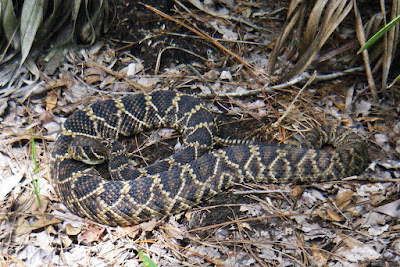
Getting on with the tale (or, in this instance “tail”), while trudging through a chunk of palmetto flatwoods in north central Florida last week, a break in the radiating palmetto leaves underfoot caught my eye – a diamondback rattlesnake! And a big one at that!

Photo was taken by Charlie, a fellow ecologist that happens to be a little faster at drawing his camera.


The eastern diamondback rattlesnake Crotalus adamanteus is the largest pitviper in the Western Hemisphere and can achieve sizes (length) of more than seven feet. Fairly common here in Florida, their range extends north along the Atlantic seaboard to the Carolinas and westward to about New Orleans, Louisiana. They do well in habitats such as palmetto flatwoods due to the ample cover provided by the palmetto leaves (“palmetto” = Seronoa repens).

The leaves provide shade for regulating body temperatures, conceal them from fumbling ecologists, and offer excellent camouflage for setting ambushes – and setting ambushes is what they do best. They lay in wait for hours, motionless; then, when the radiating heat of an approaching rabbit, bird or other delicacy enters into range, OR when a savory molecule lands on the flicking tongue (vomeronasal organ or “Jacobson’s organ”), STRIKE!

Strike indeed! Strike with the largest fangs of any rattlesnake species and with a venom pact-full of proteins adapted to produce hemorrhaging and tissue necrosis.

Here's a quick video of the same specimen. He's on the move, so I paused the video a couple of seconds at the start; his head is near the upper right-hand corner - look for the curser.


Although the food capturing mode of Crotalus adamanteus can easily be described as “predatory,” their relative contribution, or “predatory influence,” within ecosystems is not especially clear. Typically, when viewing a system’s predator-prey functionality the response and feedback between prey availability (how many are present) is weighed against the number of predators acting antagonistically within the system.

For example, one question that could be posed in regards to the predator function of Crotalus is “how does a surge in rabbit numbers (prey) affect the longevity and reproductive success (population) of the eastern diamondback?” This may seem pretty much straight forward, however; the ability of reptiles to control or impact prey populations within a given environment may be somewhat different than those of endothermic predators; after all, the biology and physiology of ectotherms is considerably different – they posses a different metabolic scheme altogether.

In examination of predator function within the Viperidae (the Family to which the eastern diamondback is a member), Erika Nowak of the US Geological Survey and others concluded that in comparison to predator-prey models established for mammals, the ectothermic vipers contribute a lesser prey population regulating potential.

The reasons for the Viperidae’s decrease in predator functionality include:
1. Longer prey handling times due to a comparatively limited digestive capability
2. Increased tolerances for fasting
3. An increased ability to convert food into fitness currency (progeny)
4. A limited ability for rapid reproductive tracking of short-term prey abundance.

Their article (Functional and Numerical Responses of Predators: Where Do Vipers Fit in the Traditional Paradigms?) Strongly points to the need for additional research in several areas behavioral ecology. I fully agree with this assessment, but for whosoever takes on the task - watch your step!


Erika M. Nowak1, Tad C. Theimer, Gordon W. Schuett (2008). Functional and Numerical Responses of
Predators: Where Do Vipers Fit in the
Traditional Paradigms? Biological Reviews, 83 (4), 601-620

Tuesday, June 23, 2009

Wildlife Photos: A Hunter of Hunters?

Took these snapshots in my backyard yesterday - this bird was watching me like a hawk!


Recently a paper was published in The Southwestern Naturalist discussing red-tails, such as this one, hunting down and feeding on American kestrels and barn owls!

I wonder what could be motivating these guys to take on such high risk prey items?


Bahm, M., & Sullivan, B. (2009). Interspecific Depredation of Raptors by Red-Tailed Hawks (Buteo jamaicensis) on San Clemente Island, California The Southwestern Naturalist, 54 (1), 85-87 DOI: 10.1894/MH-27.1