





Showing posts with label Video. Show all posts

Saturday, March 13, 2010

Evolving from Promiscuity to Monogamy

New research has revealed how the process of evolution can result in sexually promiscuous animals undergoing adaptation for monogamy.


Reproduction is an expensive endeavor. Tremendous time and resources are invested in seeking-out healthy partners, in consummating relationships, and in rearing the resultant offspring. Luckily, evolution has resulted in life being programmed to strive for resource efficiency; to work towards maximum reproductive benefit at minimum personal expense. In regards to pair-bonding between the sexes, this biological imperative for reproductive economy has made promiscuity the rule and monogamy the exception. However, despite the fact that promiscuous mating systems are the prevailing strategy in nature, environmental factors can push typically promiscuous species towards monogamy.

As a case in point, a report published in the April issue of The American Naturalist details how the ‘mimic poison dart frog’ (Ranitomeya imitator) parted ways with promiscuity to adapt a lifestyle as the first scientifically recognized genetically monogamous amphibian.

Like other frog species, poison dart frogs incur a certain amount of risk by laying their eggs in water. Although water is a biological prerequisite for frog survival, ponds, lakes and puddles also house predatory fish and other animals that prey on vulnerable eggs and tadpoles. During its evolutionary past, the menace of predation pushed the mimic poison dart frogs away from larger, riskier ponds to the considerably smaller, but safer, pools held by leaves of large bromeliad plants. Unfortunately, although the tree-top bromeliads decreased the rate of frog young predation, the movement from the big ponds raised a separate issue – nutrient limitation.

The big ponds definitely had more predators; but, they also had substantially more food. In fact, the ponds had so much food that a single frog-parent (in this case the male) was able to handle the tadpoles all by himself – a single parent family arrangement was all that was necessary to raise the next generation. In contrast, the waters held by the bromeliads averaged only about 24 milliliters in volume, far too little to hold ample provisions for a startup tadpole. In order to maintain their newly acquired safe housing, the mimic dart frogs had to adapt a new tactic.

Male mimic dart frogs had previously evolved the capacity to both transport and guard young tadpoles, but having moved to the suburbs, the females needed to help-out with feeding; rearing had become too difficult a task for the males to handle on their own. If they were to ensure the survival of their young, the days of leaving dad to care for the kids were over – monogamy was the best option. Unlike males, female mimic darts have the ability to produce eggs. To do their part, mom frogs adopted a strategy called trophic egg feeding, a practice in which they lay unfertilized eggs in the bromeliad pools for the tadpoles to eat.

An absolutely amazing video of this monogamous behavior was recorded by the BBC during the dissertation work of Jason Brown. Jason was the lead author of the cited paper, and the mimic dart footage was included in the David Attenborough narrated documentary “Life in Cold Blood.”

This is awesome footage:


Brown, J., Morales, V., & Summers, K. (2010). A Key Ecological Trait Drove the Evolution of Biparental Care and Monogamy in an Amphibian The American Naturalist, 175 (4), 436-446 DOI: 10.1086/650727

Thursday, January 14, 2010

Gharials and cobras - Water conservation

The gharial and king cobra are two of India's most iconic reptiles, and they're endangered because of polluted waterways. Conservationist Romulus Whitaker shows rare footage of these magnificent animals and urges us to save the rivers that sustain their lives and our own.


Monday, December 28, 2009

Tonight on NOVA - What Darwin Never Knew

Reminder: NOVA wil be airing “What Darwin Never Knew” on Tuesday, December 29 on PBS at 8PM ET/PT; be sure to check local listings and set the DVR. The program features Sean Carroll and details the science of Evolutionary Development - "Evo Devo"

The comapnion website can be found HERE.

Here's a preview:

Tuesday, December 22, 2009

The Flight Path of the Globe Skimmer

While living and working as a marine biologist in Maldives, Charles Anderson noticed sudden explosions of dragonflies at certain times of year. He explains how he carefully tracked the path of a plain, little dragonfly called the globe skimmer, only to discover that it had the longest migratory journey of any insect in the world.


Friday, November 27, 2009

Evolutionary and Developmental Biology - The Making of the Fittest

Sean Carroll lecturing on evolutionary and developmental biology. The talk is largely drawn form his book "The Making of the Fittest," which if you haven't read I'd highly recommend.

You'll want to fast forward to about 18:30 due to a lengthy wait before Sean's start and the removal of a copyrighted video used as an introduction.


Tuesday, November 24, 2009

Beetles and Darwin's On the Origin of Species

Good video to watch on the 150th Anniversary of the Origin's publication.

The story starts with beetles and then moves to Darwin's acclaimed work.


QUEST on KQED Public Media.

Monday, November 23, 2009

Supporting Math and Science Education

President Obama speech regarding the math and science initiative.

-Good move!


Visit msnbc.com for Breaking News, World News, and News about the Economy

Friday, November 20, 2009

A Cool Science Project...

I found this nifty new video on YouTube. The info on the page indicates that it was made for a biology class. The video overviews info on pine flatwoods ecology.

I'd give it an A+

Have a look:

Monday, November 16, 2009

Jack Horner on Dino-Chickens

Another short clip from a Jack Horner interview that appeared on CBS's 60-minutes last night. This one touches on the possibility of reverse-engineering chickens to create a dinosaur (or, dinosaur-like critter).

The Evo-devo clip with Sean Carroll (previous post) is from the same broadcast.


Watch CBS News Videos Online

Tuesday, November 3, 2009

Darwin and the Evolution of Why

Dan Dennett links culture, evolution and philosophy during a lecture in Oslo.


Sunday, October 4, 2009

Another Tool in the Exobiologist’s Toolbox

In a recent talk at TED, Garik Israelian describes how spectroscopy may help discover life on other planets…


Monday, August 10, 2009

The Threatened Gopher Tortoise

Sticking with the herpetological theme of the last couple of narrative posts (Diamondback Rattle Snakes and Spring Peepers), I thought that I’d share a couple snapshots and a short video clip of a gopher tortoise from a couple of weeks back.

This gopher tortoise, Gopherus polyphemus, was photographed in west-central Florida just outside of a planted slash pine plantation.

Most of the pine plantations in Florida have resident gopher tortoises; however these areas of anthropogenic alteration are far from ideal habitats. The plantations aren’t good for the tortoises primarily because of the fact that the plantations were established for commercial use (wood production) and were therefore seeded very densely to maximize the quantity of trees grown. The extreme density of the canopy trees drastically reduces the amount of light reaching the forest floor and affectively minimizes herbaceous growth and groundcover which the tortoises consume.

In addition to silvaculture (and as with the spring peepers), gopher tortoise populations are also heavily impacted by habitat fragmentation, which is one reason why they are listed as a Threatened Species by the U.S. Fish and Wildlife Service.
Here's a quick video of the above tortoise racing to his burrow:


For those that may not be familiar with the gopher tortoise, here’s a pile of info snagged from the Smithsonian Marine Station’s website:

Description:
The gopher tortoise, Gopherus polyphemus, is a large terrestrial turtle having forefeet well adapted for burrowing, and elephantine hind feet. The front legs have scales to protect the tortoise while burrowing. Body length averages approximately 25 cm (10 inches), with the shell ranging in height from 15 – 37 cm (6 – 15 inches). Body mass averages approximately 4 kg (9 pounds). Color is a dark brown to gray-black, with a yellow plastron (bottom shell). A gular projection is evident on the anterior plastron where the head projects out from the shell. Sexual dimorphism is evident, with male gopher tortoises having concave plastrons, while those of females are flat. In addition, the gular projection on male plastrons is generally longer than in females (Ernst and Barbour 1972).


Gopher tortoises dig burrows for cover and for nesting. These can be extensive, measuring approximately 4.7 - 11 m (14 – 40 feet) in length (Witz et al. 1991). Burrow depth is heavily dependent on depth of the local water table (Diemer 1986; Burke and Cox 1988).


Trophic Mode:
Gopher tortoises are primarily herbivorous, with the bulk of the diet consisting of low-growing herbs and grasses. Foods most common in the diet are grasses and legume fruits. They are also known to consume pine needles and seeds, oak mast, prickly pear cactus, asters, palm tree fruits, raspberries, black cherry, and gopher apples (Landers et al. 1980; Auffenberg and Franz 1982; Diemer 1986). Gopher tortoises have also been observed to eat mollusk shells and the bones of dead animals, possibly to supplement their diets with additional calcium.


Competitors:
Predators of gopher tortoises include various snakes, fire ants (Solenopsis saevissima), accipiter hawks, buteo hawks, raccoons, opossums, armadillos, skunks, dogs, foxes, feral cats and man all prey on gopher tortoises. Generally, eggs and hatchling tortoises are significantly more at risk for predation than older animals.


Habitats:
Gopher tortoises use a variety of habitats, including beach dunes, scrub, and pine flatwoods. In all habitat types, soils are generally dry, sandy and well-drained. While generally avoiding swampy areas, gopher tortoises in Brevard County, Florida have been observed to inhabit poorly-drained scrub and slash pine flatwoods (Breininger et al., 1991). In this county, higher densities of gopher tortoises were found in poorly-drained sites than in well-drained sites.
Individuals occupy distinct home ranges, with male home ranges typically being larger than those of females. In east-central Florida, home ranges of male tortoises averaged 1.9 ha (4.7 ac), while those of females averaged only 0.65 ha (1.6 ac). A tortoise excavates several burrows for its use within the home range. Burrows typically are dug at a 30 degree angle from the surface. In Florida studies, male tortoises dug between 8 – 35 burrows. Females tended not to use as many burrows as males, averaging between 3 – 17 burrows (Breininger et al., 1988).

Tortoise densities tend to be higher in fire-adapted communities (Auffenberg and Franz 1982; Diemer 1986). In the absence of fire, canopy trees grow large and shade out the herbaceous vegetation that gopher tortoises rely on as their primary food source.


Associated Species:
Gopherus polyphemus is considered a keystone species in that more than 80 different species live in their burrows, or are dependent on their burrows for protection. Some of these species, such as the gopher frog (Rana areolata), the pine snake (Pituophis melanoleucus) the indigo snake (Dymarchon corais), the scrub jay (Aphelocoma coerulescens) and in inland prairies, the burrowing owl (Athene cunicularia floridana) are rare (Burke and Cox 1988; Spillers and Speake 1988; Stout et al. 1988;Witz et al. 1991).

Sunday, August 9, 2009

VIDEO: Biomimicry in Action

Although the point of this talk is demonstrate how the natural world can provide design models for advances in human technology, what I really enjoyed about it was the awe-inspiring adaptations shown by the critters of interest – useful to humans or not. And, the image of the kingfisher diving is awesome!


From TED
Janine Benyus has a message for inventors: When solving a design problem, look to nature first. There you'll find inspired designs for making things waterproof, aerodynamic, solar-powered and more. Here she reveals dozens of new products that take their cue from nature with spectacular results.

Saturday, July 25, 2009

The Diamondback Rattlesnake’s Predatory Might

A new project at work has kept me in the field for the last couple of weeks and has severely dimensioned my time available for blogging; I should be freed up by the middle of next week and be able to get Ecographica back in gear then…

On the positive side of things, the abundance of recent fieldwork has resulted in several encounters with nature, and a slow starting Saturday has provided the opportunity to share one such wildlife sighting. However, before proceeding a warning must be forwarded; if you are lucky enough to stumble onto one of these herps in the wild, ensure that you’re stumbling is undertaken with the utmost caution – or your luck may run out very quickly! Although the below video and picture appear to be taken at close range, they in fact have been recorded at a distance and later edited from the safety of a desk.

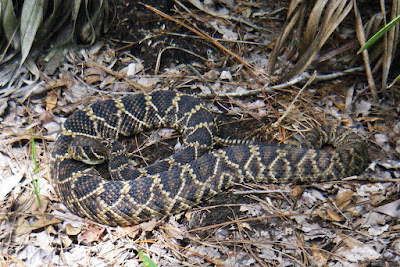
Getting on with the tale (or, in this instance “tail”), while trudging through a chunk of palmetto flatwoods in north central Florida last week, a break in the radiating palmetto leaves underfoot caught my eye – a diamondback rattlesnake! And a big one at that!

Photo was taken by Charlie, a fellow ecologist that happens to be a little faster at drawing his camera.


The eastern diamondback rattlesnake Crotalus adamanteus is the largest pitviper in the Western Hemisphere and can achieve sizes (length) of more than seven feet. Fairly common here in Florida, their range extends north along the Atlantic seaboard to the Carolinas and westward to about New Orleans, Louisiana. They do well in habitats such as palmetto flatwoods due to the ample cover provided by the palmetto leaves (“palmetto” = Seronoa repens).

The leaves provide shade for regulating body temperatures, conceal them from fumbling ecologists, and offer excellent camouflage for setting ambushes – and setting ambushes is what they do best. They lay in wait for hours, motionless; then, when the radiating heat of an approaching rabbit, bird or other delicacy enters into range, OR when a savory molecule lands on the flicking tongue (vomeronasal organ or “Jacobson’s organ”), STRIKE!

Strike indeed! Strike with the largest fangs of any rattlesnake species and with a venom pact-full of proteins adapted to produce hemorrhaging and tissue necrosis.

Here's a quick video of the same specimen. He's on the move, so I paused the video a couple of seconds at the start; his head is near the upper right-hand corner - look for the curser.


Although the food capturing mode of Crotalus adamanteus can easily be described as “predatory,” their relative contribution, or “predatory influence,” within ecosystems is not especially clear. Typically, when viewing a system’s predator-prey functionality the response and feedback between prey availability (how many are present) is weighed against the number of predators acting antagonistically within the system.

For example, one question that could be posed in regards to the predator function of Crotalus is “how does a surge in rabbit numbers (prey) affect the longevity and reproductive success (population) of the eastern diamondback?” This may seem pretty much straight forward, however; the ability of reptiles to control or impact prey populations within a given environment may be somewhat different than those of endothermic predators; after all, the biology and physiology of ectotherms is considerably different – they posses a different metabolic scheme altogether.

In examination of predator function within the Viperidae (the Family to which the eastern diamondback is a member), Erika Nowak of the US Geological Survey and others concluded that in comparison to predator-prey models established for mammals, the ectothermic vipers contribute a lesser prey population regulating potential.

The reasons for the Viperidae’s decrease in predator functionality include:
1. Longer prey handling times due to a comparatively limited digestive capability
2. Increased tolerances for fasting
3. An increased ability to convert food into fitness currency (progeny)
4. A limited ability for rapid reproductive tracking of short-term prey abundance.

Their article (Functional and Numerical Responses of Predators: Where Do Vipers Fit in the Traditional Paradigms?) Strongly points to the need for additional research in several areas behavioral ecology. I fully agree with this assessment, but for whosoever takes on the task - watch your step!


Erika M. Nowak1, Tad C. Theimer, Gordon W. Schuett (2008). Functional and Numerical Responses of
Predators: Where Do Vipers Fit in the
Traditional Paradigms? Biological Reviews, 83 (4), 601-620

Friday, July 10, 2009

Antibiotics: A Thing of the Past?

Acclaimed scientist and Nobel laureate Kary Mullis details a possible alternative to antibiotics.

Absolutely incredible!

Only about 4 min long:


Sunday, June 14, 2009

Biomimetics and Gecko-tech

Biologist Robert Full studies the amazing gecko, with its supersticky feet and tenacious climbing skill. But high-speed footage reveals that the gecko's tail harbors perhaps the most surprising talents of all.


Monday, June 8, 2009

Are There Still Big Discoveries to be Made in Biology?

Rob Dunn's March 31, 2009 presentation at the North Carolina Museum of Natural Sciences. "Life After Darwin: Are There Still Big Discoveries to be Made in Biology?"


Thursday, June 4, 2009

Science Blog Coverage on YouTube

As described on the “Kung Fu Science” channel at YouTube, Kung Fu Science is a weekly video post dedicated to providing you with exciting news from the world of science. Produced from home by a science enthusiast, the stated intent of Kung Fu Science is to share science related news from around the web.

Having watched the first three episodes, posts from the blogosphere, such as those on Pharyngula and Ecographica, seem to make up a sizable portion of the included content.

Definitely worth checking out! I've embeded Episode III below for your viewing pleasure.


Sunday, May 31, 2009

Conserving Plant Biodiversity

Quick Video - Jonathan Drori encourages us to save biodiversity -- one seed at a time. Reminding us that plants support human life, he shares the vision of the Millennium Seed Bank, which has stored over 3 billion seeds to date from dwindling yet essential plant species.


Thursday, May 21, 2009

The Hospitable Zone of Enceladus

Carolyn Porco shares exciting new findings from the Cassini spacecraft's recent sweep of one of Saturn's moons, Enceladus. Samples gathered from the moon's icy geysers hint that an ocean under its surface could harbor life.