




Tuesday, November 10, 2009

Fire Ecology and Cutthroat Ecosystem Engineering, Part 2

The phrase ‘ecosystem engineer’ refers broadly to the ability of an organism to change or modify the physical characteristics of its surroundings. When these environmental modifications resultantly impact the fitness of the engineering organism itself, the feedbacks created can be thought of as functioning like an extended phenotype. In other words, the feedbacks generated between the engineer and the ecosystem contribute to the reproductive success of the organism, and often (directly or indirectly) affect the life history of nearby competitors. In the closing line of ‘Nature Red in Tooth and Flame - Part 1’ the organisms adapted to use fire are personified as ‘cutthroat’ because they possess a genetic compliment that facilitates the shaping of their environment through a two-fold process that could easily be categorized as self-interested. Firstly, through harnessing fire these engineers are able to create a pattern of ecological disturbance that promulgates increased fitness; and secondly, the application of fire eliminates resource pilfering opposition via direct incineration. But, prior to detailing the precise methods in which ecosystem engineering plants employ fire, it is important to set the stage with a description of the battlefield – the savanna community.

In the southeastern United States savannas are typically found on relatively low topographical gradients with poorly drained soils and ample soil nutrients. Similar in biological composition to hydric flatwoods communities, savannas characteristically differ in regards to tree abundance and exhibit a relatively open canopy with a thin understory and a lavish herbaceous groundcover. Both savannas and hydric flatwoods rely on seasonal rain and fire cycles in order to maintain their soil chemistry, floral diversity and faunal components. Yes, these communities depend on fire cycles…

Prior to modern anthropogenic intervention, and the suppression of natural, seasonally occurring fire cycles, the forests, prairies and savannas of the southeastern United States experienced regular ecological disturbance by means of fire. Using Florida as an example, the annual climate cycle here is punctuated by alternating periods of relatively dry and wet weather. More specifically, the months of November through February represent the dry season and accordingly receive comparatively little precipitation. This dry season is followed by dramatically increased amounts of precipitation during summer with heavy rains and thunderstorms (particularly near the coasts) for the period including June, July and August. The spring season, February-through-May represents a transitional period from dry to wet; however the forthcoming summer brings with it thunderstorms; during this period lightening-strikes often ignite wildfires. The wildfires feed on the parched condition of desiccated plants – the wildfires thrive on the fuels remaining behind from the departing dry season. The regularity of this annual climate has resulted in a cyclic ‘fire season’ that has been recurrent for several millennia. The persistence of the fire cycle has thus contributed greatly to the structuring of local natural communities; however to understand the organismal biology of some of the fire adapted plant species a deeper gaze into evolutionary time is required. So, now that a cursory look at the battlefield has been made, a review of the actual players is in order.


Two exemplars of the fire wielding and ecosystem engineering life style are the longleaf pine (Pinus palustris) and the southern slash pine (Pinus elliottii var. densa). These trees both maintain genetic compliments – fire genes – that enable them to prosper in the flame frequented savannas of the southeastern United States. In order to appreciate the natural history of these organisms, a look at their evolutionary past is obligatory.

The longleaf pine (Pinus palustris) and the slash pine (Pinus elliottii) are two species of the genus Pinus (pine tree) which branched from genus Picea (spruce tree) during the Cretaceous Period, somewhere between 87 and 193 million years ago.


NOTE: There are two distinct varieties of slash pine, variety elliotti and variety densa, both of which can be found in southeastern U.S. and although there are several important distinctions, for purposes here both varieties can be considered one and the same, though the southern slash pine (var. densa) displays slightly greater levels of adaptation to fire.


Pine and spruce trees are grouped together with cycads, gnetophytes and ginkgo as gymnosperms, which had an initial start back in the Pennsylvanian Period of the Carboniferous more than 300 million years ago. The long history of the pine trees, and the slash pine in particular, is significant because these trees have one of the largest and most complex genomes of any organism on the planet today – a result of varied evolutionary forces. Of specific interest in regards to evolutionary history is that gymnosperms arose from the Carboniferous swamps during a period of rapid plant adaptation. In addition to the advent of the bark fiber “lignin,” plants during that period underwent a multitude of morphological changes - many of these changes were adaptations to wildfire. This was the case because unlike the 21% atmospheric oxygen present today, the carboniferous boasted 35% oxygen content, this in conjunction with an abundance of herbaceous material resulted in frequent – and intense – wildfires. Here, ‘intensity’ can be interpreted as being the ratio of a wildfire’s maximum temperature and duration; both of which can vary. The wildfires positively selected for those plant traits that phenotypically exhibited fire-tolerance, and the wildfires also actively worked to eliminate those plants that displayed fire-intolerant characteristics. Through this dualistic mechanism of natural selection, a long passed Paleozoic ecosystem worked to shape and mold the longleaf and the slash pines into masters of pyrogenic manipulation.


[This blog post continues here with installment Number 3.]


Beckage, B., Platt, W., & Gross, L. (2009). Vegetation, Fire, and Feedbacks: A Disturbance‐Mediated Model of Savannas The American Naturalist, 174 (6), 805-818 DOI: 10.1086/648458


Stevens, J., & Beckage, B. (2009). Fire feedbacks facilitate invasion of pine savannas by Brazilian pepper New Phytologist, 184 (2), 365-375 DOI: 10.1111/j.1469-8137.2009.02965.x


Sunday, November 8, 2009

Nature Red in Tooth and Flame: Fire Ecology and Cutthroat Ecosystem Engineering

Renowned journalist, publisher and geologist Robert Chambers spent the majority of his 19th Century life actively engaged in two - often antagonistic - worlds, the world of science and that of the high-society Scottish elite. It may have been his struggle to maintain balance between these two worlds, one that valued rationality and meticulous observation, the other preferring political correctness and adherence to theological dictates, which helped guide him to the decision to anonymously publish his 1844 work ‘Vestiges of the Natural History of Creation.’ The work was truly progressive by almost any measure and it would go on to influence such diverse individuals as the scientifically minded Charles Darwin and the poetically endowed Alfred, Lord Tennyson.

It was a combination of Vestiges’ theological implications and the loss of a dear friend that motivated Lord Tennyson to pen the following stanza:


Who trusted God was love indeed
And love Creation's final law
Tho' Nature, red in tooth and claw
With ravine, shriek'd against his creed
(In Memoriam A.H.H., Canto 27)


‘Nature, red in tooth and claw’ is an often quoted metaphor for natural selection, and as such, it has been a recurrent theme here at Ecographica. During several previous posts, a harmonious – ‘all is in balance’ - view of nature was contrasted with the perspective of nature as a series of oppositional organisms struggling to gain a competitive edge over rivals. During these comparisons, the ‘red in tooth and claw’ view was the hands-down victor in all cases; being both more analytically accurate, and the more observationally sound perspective. As a case in point, two recently published articles, one appearing in the December edition of The American Naturalist, the other in the July New Phytologist have compelled the issuance of an update to a post made back in April; a post that emphasized the above described contrasting views of nature. Both of the published articles lend further credence to the conceptual “fire gene,” an idea coined in the April blog. One article supports the fire gene concept through development of ecological disturbance feedback models; the other tells the story of an invasive plant with a contrasting and adversarial phenotype to the one detailed in the original post, a phenotype that suppresses fire – it bears what can be called an “anti-fire gene.” As with the original blog post, the re-write begins in the Big Cypress Preserve, with a somewhat overly embellished lead-in…


Nature Red in Tooth and Flame
Gazing across the tranquil landscape of the Big Cypress Preserve, nature seems to be in balance, unchanging and at peace - picturesque beyond any poetic description. Within this serene setting, anthropogenic throngs of sharply angled concrete and glass edifices suspend their battle for roadside commercial dominance and yield themselves to a sea of sparsely treed savannas, rolling prairies of grass, and randomly scattered islands of thickly vegetated hammocks. It’s the perfect environment for a relaxing stroll, a picnic, or, an inquiry into the natural world...

All may appear calm within this enchanting panorama with its diverse array of plants, animals and abiotic ornamentation; however, this perceived tranquility is but a chimera. It is a mere illusion of serenity resulting from shortfalls in the ability of the observer’s photoreceptors to see beyond that narrow range of the electromagnetic spectrum called visible light, an inability to hear sound outside of 22000 Hertz, and the failure of the human olfactory system to nose its way into the vast chemo-landscape of pheromones and other volatile chemicals in which it is continuously assailed. Indeed, if only the sensory apparatus of Homo sapiens was keener – if only it was more finely calibrated – the landscape of the Big Cypress would be seen for what it truly is… How very different it would seem.


Picture taken from Turner river Rd - Big Cypress Preserve


Very different indeed; imagine the ecological interplay that could be interpreted if humans could see ultraviolet light through the eyes of a bee, smell pheromones from six-miles’ distance like a moth, or interpret chemical stimuli through soil like a plant… Far from serene, if viewed through time, adaptive maneuvers, survival strategies and arms races would be manifest in every action undertaken by the immense diversity of organisms in the landscape. If these actions could be viewed more directly, if they could be seen in greater detail, the landscape would appear saturated with war; from the birds in the sky to the millions of soil bacteria underfoot, mortal conflict - not harmony - would be identified as the prime mover. Even the distribution of the apparently benign flora, the very plant community boundaries that demarcate prairie-from-savanna-from-hammock in the above described landscape, is maintained by way of fierce battles waged over evolutionary time. These ecosystems, which appear stable and so pleasingly haphazardly scattered, are in fact hordes of competing plants, all struggling for limited resources and their continued existence. It is in these contested boundaries that conflicts incessantly rage, and it is within these envied ecotones that one species has honed a new weapon – it has undergone adaptation to exploit the power of fire.

Before getting to the exploitation of fire, it is important to understand that natural plant communities exist in a continuum of environments and have adapted to inhabit almost every available niche on the planet; from “box thorns” in Death Valley to fully aquatic hyacinths floating around the lakes of Brazil, genetic plasticity in plants is clearly evidenced as a product of natural selection. And although the conquest of diverse habitats represent a surmountable challenge, a multitude of both biotic and abiotic factors conspire to determine the overall abundance (density), composition (diversity) and ultimate success of plant communities at any given location.

For example, looking across the landscape of the Big Cypress, densely concentrated hardwood trees form hammocks which, due to the broad area of their collective canopies, limit the amount of sunlight available to underlying herbaceous groundcover. This is a straight forward relationship, no sunlight reaching the ground means fewer plants on the ground. Following this rationale, if the tree canopy should be opened, say by a storm, hurricane or by the death of older trees, this would permit sunlight to temporarily penetrate to the floor and a rapid emergence (recruitment) of both herbaceous plants and new saplings would be predicted. This is precisely what happens; in this example sunlight is the limiting resource and once made available those plants best able to take advantage of the situation through rapid growth will be able to quite literally overshadow their competitors. Stated differently, plants with genetic compliments favoring a period of ‘initial rapid growth’ are at an advantage and will be positively selected if positioned to compete for sunlight with a species lacking such a genetic compliment.

Similar to the botanical quarrels described for wooded hammocks - those in which plants have undergone selection for rapid growth - plants also engage in conflict to secure access to the resources offered by prairies and savannas. And, just as with the battles for sunlight on the forest floor, contenders occupying hammock-savanna ecotones have evolved specific defensive and offensive phenotypes to aid in their advance; as alluded to earlier, a few have even acquired the ability to harness the power of fire. Like the genetic compliment that allows a plant to undergo a period of initial rapid growth when a break in the hammock’s canopy becomes manifest, some plants possess a genetic compliment that allow for direct modification of local ecology. In short, the genetic compliment allows the plant to apply heat and flame in a cutthroat effort to destroy competitors, and to assert themselves as ecosystem engineers.


[The second installment of this post is available HERE.]


Beckage, B., Platt, W., & Gross, L. (2009). Vegetation, Fire, and Feedbacks: A Disturbance‐Mediated Model of Savannas The American Naturalist, 174 (6), 805-818 DOI: 10.1086/648458


Stevens, J., & Beckage, B. (2009). Fire feedbacks facilitate invasion of pine savannas by Brazilian pepper New Phytologist, 184 (2), 365-375 DOI: 10.1111/j.1469-8137.2009.02965.x

Saturday, November 7, 2009

Field Photos: Snakes, Caterpillars, Orchids and Millipedes

I’ve been pretty tied-up the last couple of weeks, and as result the blog postings haven’t been very frequent…

As evidence to my continued existence, I thought that I’d post a few snapshots.

Hopefully, I’ll find time this weekend to put together some meatier content; until then here are a few critters that have been encountered during the previous two weeks:


Automeris io
The "Io Moth" Caterpillar

Yes, the spines can sting!
You can read more about caterpillars here - Papilio's Unconstrained Phenotypic Flexibility.


Sistrurus miliarius
The "Pygmy Rattlesnake"

As chance would have it, this one was photographed the day after my posting on pygmy rattlesnake venom.

Compare the picture here with the one featured in that posting - Venomous Fables and Phenotypic Variations at the Molecular Level.


Thamnophis sauritus nitae
The "Bluestripe Ribbon Snake"

Catching a little sun on a cypress tree's hummock this past Thursday. Poor image quality, but a beautiful snake.


Elaphe obsoleta spiloides
The "Gray Rat Snake"

His coloration and pattern is well camouflaged with the forest floor.


Spiranthes sp. ???
A orchid in the "ladies-tresses" group.

Haven't keyed this one out yet... I'm confident that it belongs to the genus Spiranthes, just not sure which one...

Compare it with Wetland Plant of The Week #16, Spiranthes praecox.


Sigmoria sp. ???
A "Millipede"

Not real good with millipede identification... I'd venture to guess that this one belongs to the Genus Sigmoria but I'm not positive...

Thursday, November 5, 2009

Wetland Plant of the Week #31

Polygala rugelii“Milkwort”

Members of the Polygalaceae Family can be found the world over, with representatives of the Genus Polygala taking credit for at least half of the total species in the group (Polygala spp. account for about 500 of the 1000 species in the family). Known commonly as “milkworts,” about 23 of the species can be found in Florida, including Polygala rugelii pictured above.


Polygala rugelii displays an irregular basal rosette with spatulate leaves, and bright yellow flowers that are arranged in dense racemes. Like all – except one - Floridian Polygala, P. rugelii is a Facultative Wet plant that has adapted to thrive in hydric flatwoods, seepage slopes and savannas (note: P. Cymosa is the only non-Facultative Wet species in Florida – It’s an Obligate).


This one was photographed about two weeks ago near Yankeetown Florida.

Tuesday, November 3, 2009

Darwin and the Evolution of Why

Dan Dennett links culture, evolution and philosophy during a lecture in Oslo.


Saturday, October 31, 2009

The Ghost Plant, a Halloween Appropriate Post

During the Iron Age in Europe, tribes residing in what is the modern day British Isles celebrated the end of summer with a pagan-rooted festival called “Samhain,” which literally translates to “summer’s end” in the Goidelic language used between the 6th and 10th centuries. In conjunction with this festival the Celts believed that the realm of the dead overlapped with the world of the living, and that through divination long dead ancestors could help foretell events of the upcoming year. Samhain is one of many festivals that contributed to the ontogeny of what is now refereed to as Halloween, and like most of the other harvest celebrations it embraced the idea of spirits and ghosts intermingling with the material world. It is in homage to such celebrations of the spirit realm that this post is written; it briefly describes a fascinating plant that has evolved to take on a ghostly appearance and to occupy a unique niche in which it parasitizes parasites, introducing the “ghost plant”.

Due to its eerie appearance and non-typical angiosperm ecology, Monotropa uniflora has been dubbed both the “ghost plant” and the “corpse plan,” though it is also called – less spookily – the “Indian pipe” (undoubtedly because of its ‘uniflora’ which when combined with an elongate stem resembles a smoking pipe). A member of the Ericaceae Family, M. Uniflora is one of about 400 angiosperm species that exhibit an achlorophyllous physiology; they lack chlorophyll and consequently don’t undertake photosynthesis as an energetic process. The lack of chlorophyll is why the plant isn’t green in appearance; rather it displays a white-to-pink hue and exhibits translucence, thus causing it to look like a mushroom or fungus.

Although not a fungus, the ghost plant does take on some fungal-like habits, but before getting to those here are a couple of snapshots of Monotropa uniflora taken earlier this week to serve as a visual aid:


Because Monotropa uniflora doesn’t photosynthesize it doesn’t require sunlight to grow and can even grow in the dark. This ability grants the plant the opportunity to do very well on forests floors which underlay dense canopies that limit the quantity of light penetrating to the herbaceous stratum. The lack of photosynthetic ability means that ghost plant implores a different strategy to acquire and process energy, like many of the fungi that it superficially resembles the plant has adapted to be parasitic.

Not only is the corpse plant a parasite, but even further it is a parasite of parasites! Monotropa uniflora is a myco-heterotroph, this means that it has developed a symbiotic relationship with a fungus. More specifically, M. uniflora parasitizes the ectomycorrhizas (ECM) found on the roots of woody trees.

So, the roots of woody trees (pine, oak, etc…) are parasitized by ECMs, such as members of the Basidiomycota and Ascomycota families and, in turn, these fungi are parasitized by an angiosperm - the ghost plant! These symbiotic relationships can be highly specialized, and in the case of the species Monotropa uniflora Young (et. al.) found that the ghost plant parasitizes members the fungi family Russulaceae specifically.

As another visual aid, here is a photo from the above mentioned research article published in the journal Mycorrhiza showing a Monotropa cluster of hundreds of mycorrhizal root tips from which several achlorophyllous stems (*) are emerging (Reference below).


Because of its spooky appearance, its inclining to parasitism and its poorly illuminated habitat the ghost plant serves as a fascinating example of adaptation and as a fitting topic for a Samhain day blog post.


Young (2002). Monotropa uniflora: morphological and molecular assessment of mycorrhizae retrieved from sites in the Sub-Boreal Spruce biogeoclimatic zone in central British Columbia Mycorrhiza, 12 (2), 75-82

Wednesday, October 28, 2009

Venomous Fables and Phenotypic Variations at the Molecular Level

Remembered for both his lucid writing ability and his tedious nature, the Greek historian Herodotus has often been criticized for the habit of adding unnecessary embellishment to his otherwise candid historical accounts. Focused primarily on the Greco-Persian Wars and personal travels around the Mediterranean, Herodotus’ works also included – on occasion – particulars that many of his 5th Century B.C. contemporaries considered questionable.

One such questionable account from Herodotus centered on the life of a certain Phrygian slave with a knack for composing short prose. Not quite Shakespearian in character, the prose rendered by this slave usually involved references to anthropomorphized wildlife and included a take-home moral message. Now typically, writing prose or verse is a rather benign enterprise, particularly when writing stories about personified animals. Moralizing on the other hand… Moralizing can sometimes get you in trouble, and regrettably for the Phrygian slave, trouble was precisely the result of his high-minded allegories - he was reportedly thrown from a precipice in Delphi for being ugly and “offensive.”

Modern historians raise doubt as to the veracity of Herodotus’ accounts of the Phrygian slave. In fact, many current scholars suspect that the slave never really existed, and further, that the voluminous writings credited to the fictional Phrygian are actually plagiarized collections of Indian folklore. Despite the questionable origins of the parables, the Phrygian slave’s name remains nearly synonymous with “allegory” to this day, and as far as I’m concerned some lessons can still be gleaned from Aesop’s Fables.

One fable in particular came to mind last Wednesday as I was traversing an ecotone between a cypress swamp and a small area of pine flatwoods near Goethe State Forest in central Florida. My eyes being drawn to the rank-and-file procession of hydrophytic plants marching from the wetlands, my ears neglected to notice the slight hum of a rattling creature underfoot. Well, the creature wasn’t quite underfoot; it was in reality about a foot’s distance from being underfoot, but none-the-less the range was sufficiently narrow to take me by surprise. After a couple of second’s pause to regain my bearings, I realized that the insect-like hum that I had heard was in actuality the warning emitted from the shaking tail of the beast – a pygmy rattlesnake!

Pygmy rattlesnakes (Sistrurus miliarius) are members of the Subfamily Crotalinae - the pitviper group - and like their larger Crotalus cousins (true rattlesnakes) the venom of the pygmy contains a toxic cocktail of tissue degrading molecules. Not exactly the kind of critter you want to accidently step on. The potency of the pygmy’s venom is uncontested and is comparable to that produced by other pit-vipers; however the quantity produced by S. miliarius is unlikely to cause death in a human – at least not the death of an adult human. As opposed to human prey, snakes belonging to the Genus Sistrurus have undergone adaptation to capture lizards, small mammals, insects and other snakes as foodstuffs, therefore striking a heavy-footed ecologist would be biting-off more than the snake could chew.

Don’t be misled however, even though the venom of the pygmy is unlikely to cause death, it would certainly pack enough punch to ruin your day; proteins “designed” to enzymaticaly induce hemorrhaging couldn’t be a good thing to have pulsing through your veins… I put the word “designed” in quotes in the previous sentence to emphasize that the protein concoction injected by Sistrurus is very much a product of adaptation - it’s a functional trait shaped by the process of natural selection. But before getting into that story, which will be forthcoming, let me first show you a snapshot of the snake encountered last week and share the Aesop fable that was alluded to above.


The Crow and the Snake
A hungry Crow spied a Snake lying asleep in a sunny spot, and, picking it up in his claws, he was carrying it off to a place where he could make a meal of it without being disturbed, when the Snake reared its head and bit him. It was a poisonous Snake, and the bite was fatal, and the dying Crow said, "What a cruel fate is mine! I thought I had made a lucky find, and it has cost me my life!" (Aesop’s Fables A New Translation by V. S. Vernon Jones, 1912 edition)


The pygmy is still considered a lucky find, though it would have been nice if the picture would have turned out a little better. I could have gotten a bit closer, but ‘as the crow teaches us’ using caution is important and un-scrupulous actions can turn a good scenario into a bad one very quickly… OK, enough with the corny fable, on with the science - before readers encouraged me to follow Aesop over the precipice!

The “designed” venom of Sistrurus… As stated above, the word “designed” refers to a natural process in which variations in phenotype have contributed to differential reproductive success between the individual organisms exhibiting the traits. Specific to this case, the proteins that make-up the hemorrhagic venom are coded for by genes contained within the snake’s genome. Variations in the venom’s genotype from individual to individual cause the overall “potency” of venom to also vary from individual to individual. So, reductively stated, variations in genes coding for venom lead to variations in the “strength” of that venom. The strength of the venom in turn affects the number and quality of prey killed by the snake.

Risking redundancy and stated a third time slightly differently, molecular alterations within the modified saliva of a snake change how those molecules fold and biosynthesize to form the constituent proteins of venom. These phenotypic variations at the molecular level translate to a modified functional trait in the snake’s predator-prey dynamic. Better venom chemistry equals more food, increased survivability and increased fecundity for the snake. Extending the gene’s reach even further, it is conceivable that the molecularly induced change in such a functional trait could even allow the snake to specialize on a certain type of prey, thereby changing its ecology all together.

Interestingly enough, earlier this year H. Lisle Gibbs of Ohio State University, and Stephen P. Mackessy from University of Northern Colorado published work in the journal Toxicon discussing the venom of several Sistrurus species. Their work centered on prey specific effects, and they hypothesized that a “high level of variation in venom at the inter- or intraspecific level allows snakes to specialize on different prey.” They tested the effects of venom on mice, lizards and frogs (typical prey items for Sistrurus) and determined that “toxicity to mammals [was] a major axis along which venom evolution has occurred among Sistrurus rattlesnakes, with little evidence for evolutionary changes in toxicity towards the other prey tested.”

So, the research published in Toxicon demonstrated that not only is the phenotypic functionality of Sistrurus’ venom significant, but also that the response to that venom by prey species may open the door to an evolutionary arms race between predator and prey - an epic battle between toxicity and immunity. Changes in venom chemistry could allow new prey items to be added to the snake’s menu, or conversely, the changes could, in time, ultimately remove current prey species from the carte du jour. Such shifts in dietary preference could easily serve as focal points for selective pressures.

I don’t know if the epic battle between snake venom and prey immunity would stir Herodotus’ interest in war writings, but the story behind the evolutionary dynamic is adequately fascinating to not require very much embellishment. As for me, I’ll take Aesop’s lesson about haste to heart and give greater attention to what’s underfoot.


Gibbs, H., & Mackessy, S. (2009). Functional basis of a molecular adaptation: Prey-specific toxic effects of venom from Sistrurus rattlesnakes Toxicon, 53 (6), 672-679 DOI: 10.1016/j.toxicon.2009.01.034

Sunday, October 25, 2009

Wetland Plant of the Week #30

Osmunda cinnamomea

“Cinnamon Fern”

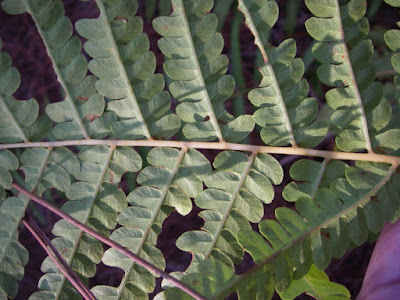
The cinnamon fern displays clustered leaves with pinnately compound fronds that taper towards their outermost tip. These fronds give O. cinnamomea a similar appearance to that of Woodwardia virginica (Wetland plant of the Week #23), however unlike the chain fern, the base of each cinnamon fern leaflet has a small tuft of orange hair that is visible when the undersides of the fronds are examined - pictured in the last image below.

The fern is not the source of the spice “cinnamon,” rather the cinnamon fern gets its common name from the rusty brown colored (i.e. cinnamon-colored) reproductive structures attached to the specialized (spore-bearing) fronds emerging from the center of the plant – pictured in the image below.


A rhizomatous fern, the roots of O. cinnamomea are highly fibrous, black in color and can grow to form a thickly woven mat as the plant matures. These wiry root masses are often harvested for use as planting substrates in horticulture, which is why the United States Agricultural Service lists the cinnamon fern as commercially exploited here in Florida and as vulnerable in New York State.

The specimen above was photographed last week near Goethe State Forest

Tuesday, October 20, 2009

Connecting Carl Sagan, Richard Feynman and Neil degrasse Tyson

Wow… Carl Sagan, Richard Feynman, Neil deGrasse Tyson and… Bill Nye (?) groove to a music track by John Boswell.

Weird, strange, cool, funny, geeky and nerd-tastic...


There’s another one featuring Hawking at http://www.symphonyofscience.com./

Monday, October 12, 2009

Wetland Plant of the Week #29

Agalinis purpurea

Purple False Foxglove

One of twelve Agalinis species found in Florida, the purple false foxglove has widely spreading branches, lacks axillary fascicles and displays corollas longer than 2cm.

A Facultative Wet species with geographic distribution over the eastern half of North America, Agalinis purpurea can be found in hydric pine flatwoods, bogs and seepage areas.


These were photographed last week near Aucilla Wildlife Management Area in northwest Florida.

Tuesday, October 6, 2009

Field Photos: Caster canadensis does some landscaping

While doing some fieldwork in north Florida last week, I stumbled across a small duckweed covered pond. This discovery was unexpected…

It was unexpected because, prior to going to field, I had reviewed aerial photos of the area in hopes of identifying any potential wetlands on site – this pond wasn’t on the aerials.

On closer examination of the pond, I noted that several upland species of trees had recently been inundated by the pond and appeared to be in poor condition; it was a new pond and the trees were being overtaken by the water and slowly drowned…

Then I happened onto direct evidence of the crime and suddenly realized the identity of the culprit!


Looking at the scene, I was reminded of Richard Dawkins’s description of beaver-effects in his book The Extended Phenotype.

I guess that the new pond can be viewed as being the result of rodent genes…

At any rate - and despite the ecological renovations shown above - beavers (Caster canadenis) don’t have quite the impact on the landscape down here in the southeastern United States as they do in more northern regions of the Americas. A recent study published to The American Midland Naturalist examined the affects that beavers have on the landscape in southern Georgia – which is less than 90 miles from where the above images were taken in Florida.

What the scientists found was that lower population densities of beaver in the southeast, in conjunction with the year around availability of food, lessened the intensity of beaver induced impacts.

Brzyski, J., & Schulte, B. (2009). Beaver (Castor canadensis) Impacts on Herbaceous and Woody Vegetation in Southeastern Georgia The American Midland Naturalist, 162 (1), 74-86 DOI: 10.1674/0003-0031-162.1.74

Monday, October 5, 2009

Poor Conservation or Good Business?

(This post has been temporarily removed for revision)


Reiss, K., Hernandez, E., & Brown, M. (2009). Evaluation of Permit Success in Wetland Mitigation Banking: A Florida Case Study Wetlands, 29 (3), 907-918 DOI: 10.1672/08-148.1