




Wednesday, May 20, 2009

A Nine-spotted Predator in my Backyard


While walking the dog yesterday I discovered this aphid buffet line in my backyard:


The rosy apple aphid (Dysaphis plantaginea) produces approximately 6-9 generations annually. Dense colonies (as pictured) are typically produced in middle-to-late May and are devastating to plants. After reaking havoc, the aphids will then migrate to new plants through the beginning of August. Eggs, which remain dormant until the following spring, are produced in the fall.


The aphid eggs hatch around April to produce viviparous females that will in turn parthenogenetically produce about 70 apterous virginoparae. The virginoparae will later generate a sexually reproducing generation (sexuparae) as well as males.

Their impact on plants combined with the ability to reproduce parthenogenetically makes the aphid a formidable foe – but there is a defense.
Here it comes now.

Here's a stare down between an aphid and the seven-spot ladybug Coccinella septempunctata:


The predatory attack of Coccinella septempunctata - the aphid hunter:

Coccinella septempunctata is one of several ladybeetles found in Florida, for a listing click HERE.

Throughout the United States non-native coccinellid populations are on the rise. The primary reason for this increase is most likely the establishment of exotic ladybeetles with the ability to out compete, the locals for vital food resources.


For native Florida ladybugs, those food resources are aphids, and with the exception of Neoharmonia venusta, which is a predator of psyllids (jumping plant lice), all of beetles listed above find them quite delicious.


Another contributing factor to native beetle strife may be the commercial sale and transport of ladybeetles for the purpose of agricultural defense. Although the beetles are a tremendous aid in protecting crops, the increased cross-regional exchange of fauna may be accelerating the spread of pathogenic and parasitic organisms that prey on the ladybugs.


In regards to natives being out competed for food resources, Susan Moser and John Obrycki of the University of Kentucky found that when food resources are plentiful exotic ladybeetle species, such as Harmonia axyridis and Coccinella septempunctata experience higher fecundity than the locales and can expand their numbers very quickly. When food resources aren’t as accessible the natives prove to be a heartier species and sustain reproductive rates that out pace the immigrants.

Special thanks to David Almquist from the Florida Natural Areas Inventory for help with the lady beetle ID.


Moser, S., & Obrycki, J. (2009). Competition and Intraguild Predation Among Three Species of Coccinellids (Coleoptera: Coccinellidae) Annals of the Entomological Society of America, 102 (3), 419-425 DOI: 10.1603/008.102.0310

Paleostitute spp. [pey-lee-uh- os-ti-toot]

Paleostitute spp.
[pey-lee-uh-os-ti-toot]

-noun
A derivative of the words “paleontologist” and “prostitute;” referring generally to a scientist whom allows money, fame or notoriety to interfere with scientific study or the established methods of scientific research.

Example: "After receiving a handsome stipend from the local church, the paleostitute provided research data which clearly demonstrated tiktaalik to be a golden retriever with scoliosis.”


The wildtype paleostitutes typically exists as one of two species:

Paleostitute major
A species of scientist specializing in the subject areas of paleontology, paleoecology or paleoanthropology that willingly and fraudulently alters, modifies or misrepresents research for purpose of receiving direct payment.

Paleostitute minor
A species of scientist specializing in the subject areas of paleontology, paleoecology or paleoanthropology that willingly exaggerates the significance of scientific evidence for the purpose of publishing a popular work, reinforcing previously held hypotheses, creating a documentary on the History Channel, receiving free drinks at a tavern or impressing members of the opposite sex.

Ida and the Jurassic Park Effect

I just downloaded my copy of the sensational, upcoming movie-of-the-week the “Complete Primate Skeleton from the Middle Eocene of Messel in Germany.”

Though after only a cursory flip through, I find myself rather confused...? The article in hand appears to be of a scientific nature, with an abstract, introduction and discussion section – what’s the deal? Based on recent hype I was of the understanding that Ida was a scarcely clothed partygoer and heiress to the Hilton Hotel chain?

Ok, well maybe Ida isn’t all that, but I must admit, based on the photographs glanced so far, “daddy likes what he sees.” Talk about sexy…

Darwinius masillae (AKA “Ida”) may very well represent the most complete fossil primate yet discovered and boasts a full skeleton, a soft body outline and even the contents of the digestive tract - an absolutely amazing fossil!


Although the concerns expressed by Brian Switek in his post A Discovery That Will Change Everything (!!!) ... Or Not are perfectly valid, in this instance I find myself torn between two opposing views of Ida’s coverage…

On one hand, the cheapening of the discovery through exaggeration and media hype may be indicative of a peer review process that is becoming more susceptible to commercialization and influence by those not in the know – a situation in which the public’s scientific understanding is purchased at cost via movie-of-the-week deals instead of from knowledgeable and articulate sources.

On the other hand, having spent time on my hands-and-knees, under a southwestern Wyoming sun, meticulously scanning every inch of Wasatch for the most minuscule of dentary fragments, I find the fossil itself absolutely astonishing! Indeed, so astonishing that I have little doubt that there are young men and women today flipping on the TV and upon viewing Ida’s images becoming motivated – inspired even – to pursue careers in the natural sciences.

As I’m sure Paris Hilton would agree, even bad media can be good media. And like a theatrical movie that is woefully inaccurate but still has the power to thrill an audience or capture the imagination, Ida’s coverage is a two sided sword. The “Jurassic Park Effect” may initially result in misunderstanding, but ultimately it leads the masses to a world they may have never known otherwise. I just hope that the majority are bright enough to seek “truth” and not to accept popular media as fact.

As for the real science behind Ida’s fame, I don’t know; I’ve yet to read the paper. But what I can attest to is that Jens, Philip, Jorg, Jørn, Wighart and Holly have put their research to paper and have been published. Irregardless of where Ida’s phylogeny may be found on the History Channel, it is in the scientific community that her history will ultimately be judged – and that is exactly how it is supposed to work.

I'm not suggesting that there isn't some "paleostitution" here, but the current media situation could always be worse, instead of Ida we could be inundated with coverage of the other scarcely clothed partygoers and heiresses…

Also checkout
Poor, poor Ida, Or: "Overselling an Adapid" @ Laelaps

Darwinius masillae @ Pharyngula

Darwinius: It delivers a pizza, and it lengthens, and it strengthens, and it finds that slipper that’s been at large under the chaise lounge for several weeks… @ The Loom

Franzen, J., Gingerich, P., Habersetzer, J., Hurum, J., von Koenigswald, W., & Smith, B. (2009). Complete Primate Skeleton from the Middle Eocene of Messel in Germany: Morphology and Paleobiology PLoS ONE, 4 (5) DOI: 10.1371/journal.pone.0005723

Tuesday, May 19, 2009

Video - "Darwinius masillae"

Sir David Attenborough said Darwin "would have been thrilled" to have seen the fossil - and says it tells us who we are and where we came from."This little creature is going to show us our connection with the rest of the mammals," he said."This is the one that connects us directly with them."Now people can say 'okay we are primates, show us the link'."The link they would have said up to now is missing - well it's no longer missing."A team of the world's leading fossil experts, led by Professor Jorn Hurum, of Norway's National History Museum, have been secretly researching the 1ft 9in-tall young female monkey for the past two years."

Quammen on Darwin

Good write-up, swiped from Here

By ED KEMMICK – Billings Gazette

Charles Darwin, who fundamentally altered the way scientists view the world and whose ideas are nearly as inflammatory today as they were when he announced them to the world 150 years ago, was a quiet, kindly homebody who was literally sickened by excitement and dispute.
And though he is known now for one big idea, the theory of evolution by natural selection, Darwin spent his life, in the words of David Quammen, immersed "in the beautiful significance of tiny details."

Quammen [at right] is a science writer who lives in Bozeman. Having spent most of February and March delivering lectures on Darwin around the country, Quammen said he sometimes felt a little presumptuous, given that Darwin apparently never gave a single public talk on evolution.


"It was hard for him even to have a really animated discussion with one of his friends without being sick the next day," Quammen said.

Darwin is the subject of renewed interest this year because it is the 150th anniversary of the publication of "On the Origin of Species" and the bicentenary of his birth in England on Feb. 12, 1809.

Quammen is in demand because he has spent much of his career writing about evolutionary biology. He delivered a speech on Darwin at the Library of Congress in 2002, and in 2006 he wrote "The Reluctant Mr. Darwin," a short biography. He also served as general editor and wrote an introduction for a big, new illustrated edition of "The Origin" published in October.
He has lived in Bozeman since the 1970s and is now in his third and final year as the Wallace Stegner Distinguished Professor of Western American Studies at Montana State University.
He said he has been surprised "to find myself sort of a tinpot Darwin expert. ... I'm not trained as a scientist myself. I'm not an evolutionary biologist. But I've been in love with this guy and his work for a long time." ................


Link to Billings Gazette to Continue

Monday, May 18, 2009

Quick Video - Haeckels Embryos and Creationism

This may be an old video, but it's the first time I've seen it.

Classic creationism tactic - and typical Fox News reporting...


Sunday, May 17, 2009

Size Matters, But So Does Maturity

Starting in the 1940’s, Angelo Siciliano pioneered the cultural meme of “brawn over brains” and actively encouraged the males of one mammalian species - Homo sapiens - to pack on muscle in order to win over rivals for the affection of potential mates. However, lost to Charles Atlas was the possibility that the iconic “97-pound weakling,” which he vowed to aid through a rigorous program of dynamic-tension, may have been capable of achieving success on his own, independently of an increased body size. Key to such success would be to avoid the gauntlet of bullying sand-kickers altogether thereby reducing the necessity for brute force, and rather than investing in mail order fitness regimens, to instead turn the “chump to a champ” through allotting resources to two key areas - growing-up fast and getting to the female first!


Thanks to the vector of modern media, Angelo’s meme is still infectious today (among populations of H. sapiens) and has probably met with some limited success; however there are several species that have found competitive advantage in strategies other that those associated with an increased body size – one such animal is the redback spider of Australia.

The redback, Latrodectus hasselti, is a polyandrous species in which intrasexual selection relies less on choosey females and more on males competing for access to un-mated –“virgin” - females. Virgins are preferred by the male redbacks because, as with many other spiders, the males introduce a post copulatory plug to the female following sex, this has the effect of decreasing the likelihood of secondary male suitors successfully transferring genetic material – to have the best probability of forwarding their germ line to future generations, male redbacks seek out virgins. The virgin status of redbacks is identified by the males through a pheromone signal emitted by the female; within hours of mating, these chemo-signals cease being produced and the female becomes less attractive as a potential mate.


Typically, sexually mature males of the species, having converged on the virginal pheromone, will find themselves geographically amassed at the female’s web with as many as five other males vying for mating access. When this occurs, the males combatively engage each other until a single victor remains. To the victor goes the mate.

When it comes down to brute force, generally the male with the best weapons, most strength or greatest mass has the advantage in combat. This polyandrous scenario is familiar to most, but generally images of big horn sheep ramming each other, or gladiatorial deer with interlocked antlers are called to mind; the spiders are little different… Little different - except for an alternative intrasexual strategy to which some males find themselves better adapted.

By way of sexual and natural selection, some male redbacks have decided that because of the dynamic between pheromone signaling, male-to-male competition and copulatory plugs, that it may be better to focus more on being the first to achieve sexual maturity via rapid development than to spend extra effort and time in growing to a larger size. In this way they would have first access to females, avoid web-sparring with males and because of the pheromones, even discourage rivals post copulation. Even Charles Atlas could respect that!


KASUMOVIC, M., & ANDRADE, M. (2009). A change in competitive context reverses sexual selection on male size Journal of Evolutionary Biology, 22 (2), 324-333 DOI: 10.1111/j.1420-9101.2008.01648.x

Saturday, May 16, 2009

Wetland Plant of the Week #17

Aletris farinosa

"White colicroot"

Superficially, Aletris farinosa resembles Wetland Plant #16 from last week’s post; however A. farinosa isn’t an orchid but rather a lily (Liliaceae). Although classified as Facultative in Florida, colicroot is adapted to hydric flatwoods and marginal areas of marshes and bogs. A. farinose is a perennial with a spike-like raceme of flowers arranged along the leafless stem and displays a flat rosette of leaves at the base.


“Jay the Banjo Picken’ Botanist” photographed this one in Levy County, Florida.

Friday, May 15, 2009

Mutualism in Situ – Fossilized Symbionts

A chunk of fossilized amber recovered from a mine in the Hukawng Valley of Myanmar has been found to encase a Cretaceous termite with several species of formerly egressing protozoa attached to an abdominal wound sustained more than 100 million years ago. This snapshot of symbiosis demonstrates that the relationship between the cellulolytic protist and its eusocial dwelling have been a long time in the making.


Cool fossil… Here’s the background section of the article:

Termites are one of the most successful eusocial insect groups today and certainly the most notorious as a result of their damage to human dwellings. Their success can be attributed in large part to microbial (especially protozoa and bacterial) symbionts harbored in their alimentary tract. Especially important are gut protists, which are essential for the survival of termites feeding on lignocelluloses. While termites do produce endogenous cellulases from salivary glands and gut cells, cellulolytic protists are crucial for the complete digestion of cellulose in wood-feeding termites. In the lower termites, these symbionts are mostly flagellates belonging to the Oxymonadida, Trichomonada and Hypermastigida. Flagellates associated with an Early Cretaceous lower termite of the family Kalotermitidae are described and compared with mutualistic flagellates of extant kalotermitids. This discovery shows that, while the protist species represent different genera and species, mutualistic associations between protists and termites had already been established some 100 million years ago. The present study represents the earliest fossil record of mutualism between microorganisms and animals.

The full text and several images can be found free HERE.


George O Poinar Jr. Description of an early Cretaceous termite (Isoptera: Kalotermitidae) and its associated intestinal protozoa, with comments on their co-evolution. Parasites & Vectors, 2009; 2 (12) DOI: 10.1186/1756-3305-2-12

Thursday, May 14, 2009

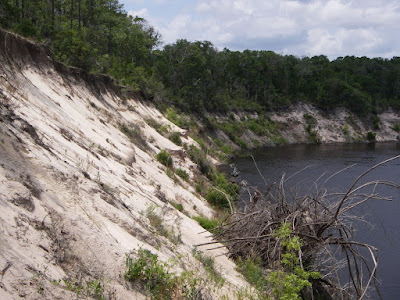
There’s Topography in Florida - who knew?

Just returned from a week of field work in Nassau County, Florida; although I wasn’t able to make very many posts the last couple of weeks, I did accomplish two very important tasks…

One, I provided much needed sustenance for thousands of apparently starving mosquitoes and horse flies, and two, I was able to view – and photograph – the greatest topography transition I’ve seen since relocating to Florida six years ago. It’s a bluff along the Bells River near the Georgia-Florida State line.

Might not look like much, but for Florida it’s not too shabby…


...Watch your step!


A quickly peiced together panoramic view...

Sunday, May 10, 2009

Frog Ears and Ultrasonic Playback

The first amphibian known to call exclusively in the ultrasonic is identified!

"You look at the frog and can see it is vocalizing — you can tell because their vocal pouches pulsate — but you don't hear any sound. It's amazing. Then you look down at the recording equipment and see the lights flashing, indicating sound. I have never seen that before. In a frog, it's unprecedented to have purely ultrasonic vocalizations." Victoria Arch, UCLA grad student.

The “hole-in-the- head” frog (Huia cavitympanum) - so called because of its recessed ear drums- resides in hillside forest ecosystems of Borneo and Southeast Asia at elevations between 250 and 1000 meters. It is unique among the Ranidae for its ability to vocalize and hear ultrasound calls – well outside of the human range of hearing.


According to Victoria Arch, one of the authors of a recent paper published at PLoS One describing the communication of Huia cavitympanum, "Our hypothesis is that these frogs have shifted to use higher frequencies in their communication to avoid the interference of sound produced by rushing water in the lower-frequency range. However, high-frequency sounds do not transmit as far. By producing some lower-frequency calls, they can transmit calls over a greater distance, so they can communicate with frogs that are farther away. But by also producing some calls that are high-frequency — all ultrasonic — they may be able to communicate better over that background noise. Producing both types of calls might be a bet-hedging strategy to be heard," Arch said. "This is how males attract females, communicate with one another and establish territorial boundaries."


H. cavitympanum relies on fast moving streams for reproduction; these sometimes torrential waters may have necessitated enhanced communication tactics in order to affectively stake out territories and attract potential mates. The tadpoles of the species have also adapted to streamside existence - they’ve developed huge abdominal suckers in order to suction-cup themselves to the sides of rocks.


Abstract (Full Article Here)

Huia cavitympanum, an endemic Bornean frog, is the first amphibian species known to emit exclusively ultrasonic (i.e., >20 kHz) vocal signals. To test the hypothesis that these frogs use purely ultrasonic vocalizations for intraspecific communication, we performed playback experiments with male frogs in their natural calling sites. We found that the frogs respond with increased calling to broadcasts of conspecific calls containing only ultrasound. The field study was complemented by electrophysiological recordings from the auditory midbrain and by laser Doppler vibrometer measurements of the tympanic membrane's response to acoustic stimulation. These measurements revealed that the frog's auditory system is broadly tuned over high frequencies, with peak sensitivity occurring within the ultrasonic frequency range. Our results demonstrate that H. cavitympanum is the first non-mammalian vertebrate described to communicate with purely ultrasonic acoustic signals. These data suggest that further examination of the similarities and differences in the high-frequency/ultrasonic communication systems of H. cavitympanum and Odorrana tormota, an unrelated frog species that produces and detects ultrasound but does not emit exclusively ultrasonic calls, will afford new insights into the mechanisms underlying vertebrate high-frequency communication.

Photographic Credits: Frogs of Borneo

Arch, V., Grafe, T., Gridi-Papp, M., & Narins, P. (2009). Pure Ultrasonic Communication in an Endemic Bornean Frog PLoS ONE, 4 (4) DOI: 10.1371/journal.pone.0005413

University of California, Los Angeles (2009, May 9). Ultrasonic Communication Among Frogs. ScienceDaily. Retrieved May 9, 2009, from http://www.sciencedaily.com/releases/2009/05/090508192231.htm
Posted by Johnny at 5:45 PM 0 comments

Friday, May 8, 2009

Neil Shubin on Tiktaalik & Transitional Fossils

Neil Shubin, Associate Dean of the Biological Sciences Division at the University of Chicago describes how his diverse fossil findings allow him to devise hypotheses on how anatomical transformations occurred by way of genetic and morphogenetic processes.